MDR vs EDR: What Each Covers and How to Choose

.avif)
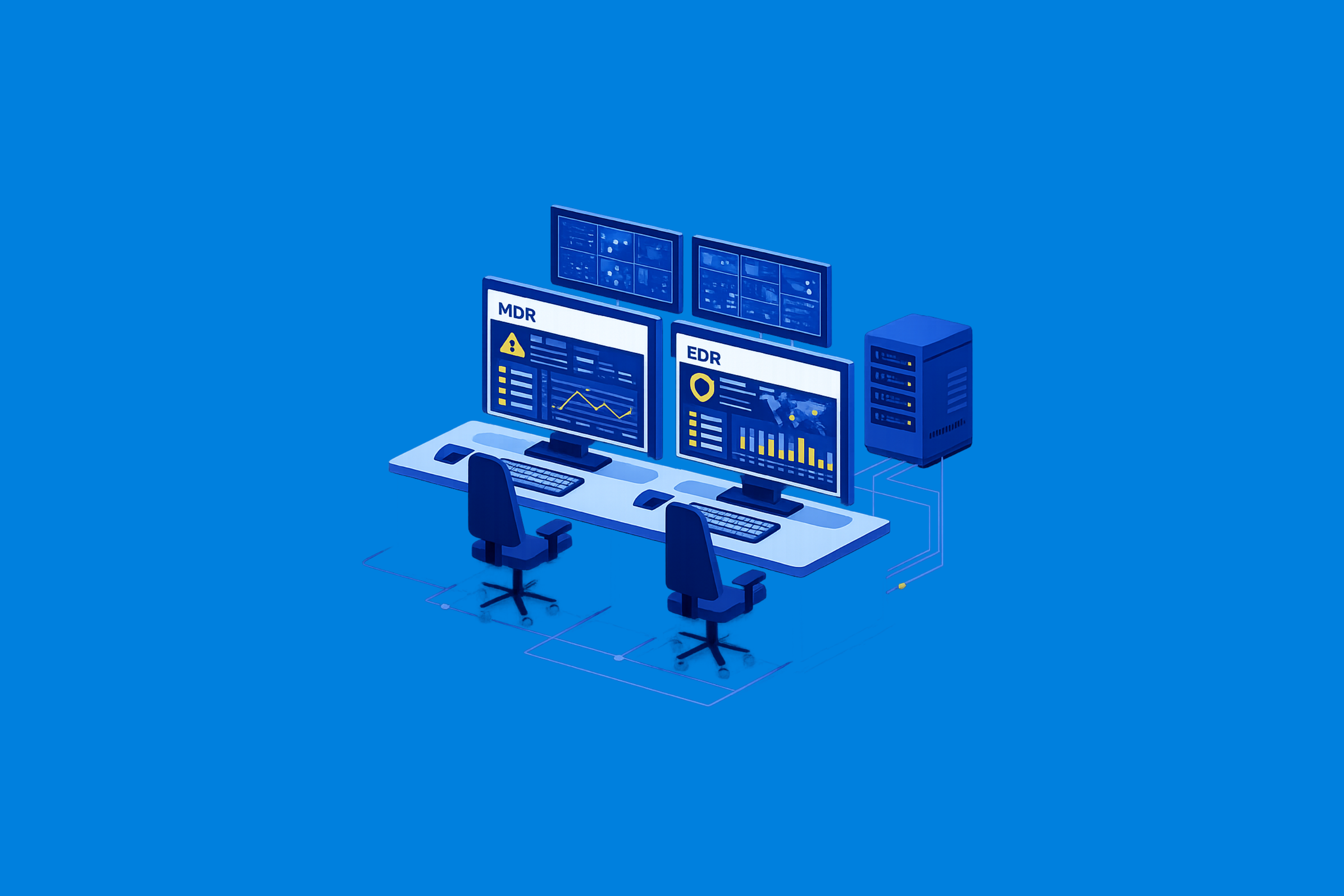
MDR vs EDR reads like a product comparison, and that framing is why a feature matrix rarely settles it. EDR (Endpoint Detection and Response) is a security tool you deploy to endpoints. MDR (Managed Detection and Response) is a service where a provider monitors, investigates, and responds to threats on your behalf 24/7/365. One detects issues. The other triages, investigates, and responds.
Most teams need both. The real question in MDR vs EDR is who owns the operating model when something fires at 2 AM. The on-call engineer has a process tree on their phone, no identity context, no visibility into whether the flagged account has active sessions in AWS or Okta, and no way to tell if the lateral movement signal correlates with anything else in the last hour. The EDR did exactly what it was designed to do. The team still has to do everything else. The 2 AM scenario is the clearest test of how much of that model your team can run itself.
TL;DR:
- MDR vs EDR is not a feature question. MDR is a service; EDR is a tool, and the decision turns on who owns the work once an alert fires.
- EDR solves real problems on the endpoint: telemetry, local detections, and containment actions like host isolation and process termination. Staffing a SOC, assembling cross-system context, and owning response decisions sit outside its scope.
- The 2 AM problem exposes the gap between capability and coverage. Coverage requires an operating model with context, authority, and the ability to investigate and act when the alert fires.
- The right answer is rarely "EDR alone" or "MDR alone." It comes down to which parts of security operations your team owns and which parts you outsource, with the 2 AM scenario as the gut check.
The Difference Between MDR and EDR
EDR, Endpoint Detection and Response, is software installed on endpoints that records process activity, detects suspicious behavior, and can take automated actions like isolating a host. MDR, Managed Detection and Response, is a security service where a provider handles monitoring, investigation, and response on your behalf. The first is a product your team operates; the second is an operation someone runs for you. A team can buy EDR without buying MDR, buy MDR that uses someone else's EDR, or buy both from separate vendors.
They get compared constantly because they occupy adjacent space in a security budget. But comparing them on a feature matrix is like comparing a commercial kitchen with a catering contract. One is equipment. The other is someone cooking for you.
The distinction matters because most teams need both layers working together. EDR sits underneath the operating model as a tool category. It does not become a service just because it generates more alerts.
MDR vs EDR at a Glance
EDR and MDR sit in different layers of a security program, and the differences show up most clearly in who operates them and what arrives at the end of the work.
Both columns describe real work that has to happen somewhere. The practical question is how much of it your team is staffed to do at every hour of the week.
What EDR Owns
Endpoint telemetry includes process execution, file mutations, and network connections. EDR also provides local detections using signature-based and behavioral methods, containment actions like host isolation, process kill, and file quarantine, and forensic data for post-incident analysis. The tool is deep on the endpoint: it records what happened, flags what looks suspicious, and can act quickly on high-confidence detections.
What EDR Leaves to Your Team
EDR leaves the rest of security operations to your team. The team is responsible for tuning detection rules, monitoring the alert console around the clock, and triaging what fires. It also correlates endpoint signals with the identity and cloud signals the tool does not collect, decides which alerts represent real threats, and executes response decisions that reach beyond a single endpoint. The team also owns 24/7 coverage, on-call rotation, authority to take action on production systems, and the full audit trail for compliance. An EDR is a complete tool and an incomplete operating model.
The 2 AM Problem in Security Operations
The 2 AM problem is the operational test that exposes whether a team has bought capability or coverage. Capability ships with the license. Coverage is people, authority, and context, on shift, at the moment an alert fires.
Who Gets Paged
An alert at 2 AM reaches the on-call engineer, often a single person whose primary job during business hours is something else entirely. Rotation depth decides whether that person has anyone to hand the case to.
Who Has Access
Many alerts fire on systems the on-call does not have direct access to. Pulling additional context from identity tools like Okta or Entra ID requires authenticating into a separate system that may not be immediately available.
Who Has Authority to Act
Containment decisions on production systems usually require explicit authorization from someone more senior. Isolating a production endpoint that turns out to be a false positive causes a self-inflicted outage. Leaving a genuinely compromised endpoint in place lets the attacker move. Neither decision is professionally safe without accurate context and explicit authority.
Who Has Context
The alert payload from an EDR is endpoint-shaped. The decision the on-call has to make is business-shaped. Whose machine is this? What does this user normally do? Does this correlate with cloud control-plane activity? Months of high false-positive volume have conditioned the on-call to be skeptical of every alert, and they are operating on interrupted sleep. The structural conditions degrade decision quality at the moment when decision quality matters most.
Around-the-clock monitoring coverage takes a team, and most small-to-mid-market security teams cannot staff to that level for monitoring alone, much less for investigation and response. Coverage is an operating-model problem, not a tooling problem. MDR exists because the gap cannot be closed by hiring alone.
What MDR Adds on Top of EDR
MDR is a service that runs the operating model. At its core it is a remotely delivered SOC operation that handles detection, investigation, and response on the customer's behalf, with the provider owning the work end-to-end through to resolution. Day to day that means continuous coverage, managed investigation, response actions the provider executes or coordinates, and periodic reporting.
Where MDR Providers Differ
MDR is not a uniform service. Some providers investigate a defined set of alert types and hand the more complex cases back to your team. Others investigate across identity, cloud, and SaaS, reach a verdict, and involve you only when a case turns out to be real. Investigation depth, response authority, and how the provider's analysts are structured into the service all vary. Operational ownership runs deeper with some providers than buyers usually expect.
The market splits three ways on who runs the work. Traditional MDR is provider-run and human-heavy, with higher escalation volumes. AI SOC tools are customer-operated software that automates triage and investigation and returns findings your team acts on, so ownership of response stays in-house. AI-native MDR is provider-run on an AI-native architecture, with the provider owning investigation and response under an agreed scope. The three differ on operating model and accountability, which shapes the buying decision more than any feature list.
The practical question to ask any MDR provider is what work they actually finish before your team gets involved.
How to Read an MDR's Operational Depth
A provider that investigates through to a clear verdict and handles agreed response actions is operating the service. A provider that mostly forwards ambiguous alerts is giving you another queue to work. When a case does escalate, what arrives with it tells you the same story: timestamps, evidence, business context, and verdict rationale mean the provider is resolving the 2 AM problem, and a one-line summary means the problem has simply moved.
How EDR and MDR Split Operational Responsibility
The useful comparison asks where the investigation burden sits: with your team, shared, or fully owned by the provider. EDR and MDR have different jobs, and "good" looks different for each.
Every responsibility your team owns in the EDR-only column has to be staffed by someone who is awake, authorized, and holding enough context to act.
With EDR Only
Your team owns monitoring, triage, investigation, decision-making, response execution, on-call rotation, escalation authority, and the full audit trail. The EDR provides telemetry and a few automated containment actions. This is workable for teams with senior in-house staff, defined on-call rotations with enough depth to carry an investigation through, and the authority structure to act on production systems off-hours.
The EDR itself has to be good. It detects across signature, behavioral, and machine-learning methods without heavy agent overhead, contains reliably, and keeps telemetry queryable down to the full process tree. Retention depth matters as much as detection quality, because investigations into long dwell times depend on data that has not aged out. Tuning hooks matter too, so your team can adjust detections by policy group without filing a vendor ticket.
With MDR
The provider takes on monitoring and investigation. Response ownership depends heavily on the contract. In tighter MDR engagements, the provider executes containment actions within pre-authorized boundaries. In looser ones, the provider notifies the customer and recommends actions but stops short of executing them. Read the contract carefully.
Good MDR shows up as clear ownership of the incident lifecycle from alert through resolution. Escalations stay low-noise, measured in cases per month, and the ones that do arrive carry specific timestamps, evidence artifacts, and MITRE ATT&CK technique mapping alongside the response actions already taken or recommended. Coverage reaches identity and cloud as well as the endpoint, and the reasoning stays visible, so the customer can see what the provider checked and how it reached the verdict.
Where Cloud, Identity, and SaaS Visibility Comes In
EDR is endpoint-centric by design. Okta logins, AWS control-plane activity, and Microsoft 365 audit events sit outside what an endpoint agent collects. MITRE ATT&CK treats Identity Provider, IaaS, SaaS, and Office Suite as four separate platforms in its Enterprise cloud matrix. Attacks that move through those layers often leave thin traces on the host, which means most real incidents cannot be resolved from endpoint data alone.
A credential compromise in Okta and a privilege escalation in AWS rarely surface in EDR on their own, which is part of why some teams look at XDR as an alternative or complement to close the coverage gap. MDR providers vary in how seriously they invest in cross-system coverage. The 2 AM case is more often a multi-system problem than a pure endpoint one.
When You Are "Running MDR Yourself"
A team can become its own MDR without ever deciding to. The on-call rotation is constantly paged, internal triage time per alert keeps growing, senior engineers spend more hours on false positives than on building anything, and threat hunting sits on the roadmap and never gets scheduled. At that point the team is running an MDR operation without the staffing or operating model to do it well.
You Don't Need to Decide Between EDR and MDR
Most teams already run EDR, and adding MDR does not mean replacing it. In practice MDR vs EDR is a scoping decision: which parts of security operations the team keeps, and which parts a provider runs on top of the tooling already in place.
When EDR Only Is Enough
Keeping the work in-house holds up when the security team is senior enough to work an incident unsupervised, the on-call rotation is deep enough to absorb a bad night, and the headcount exists to investigate alerts around the clock. Leadership has to be comfortable owning every incident, including the ones that go wrong. The teams this describes usually got there on purpose, having staffed for the people, the authority structure, and the cross-system visibility it takes to act at 2 AM.
When MDR Becomes Necessary
The case for a provider builds when headcount is limited and no realistic path to 24/7 staffing exists, and when multi-cloud and identity attack surfaces keep generating alerts the EDR was never positioned to see. Weekend pages wear the team down. Investigations stall on context nobody has time to assemble. The clearest signal is an environment where the team cannot reliably reach a verdict and a resolution during off-hours.
Solving the 2 AM Problem With an Operating Model, Not a Tool
No EDR feature set closes the gap between an alert firing and someone reaching a verdict. Only an operating model does. The question at 2 AM is who is awake, who can run a cross-system investigation, and who has the authority to act.
MDR providers run that operating model differently. Some still lean heavily on manual investigations and narrower visibility across systems. Others investigate with broader telemetry and business context, clearing alert backlogs and escalating only when a case needs your attention. Daylight is built around the second approach.
Daylight is a MASS company, meaning it offers managed agentic security services for Security Operations on an AI-native platform. Its AI MDR service investigates alerts to resolution. Investigations start from alerts in your existing tools, including your EDR, and from proprietary detection rules running on streaming log data, which opens investigations on signals the existing stack does not act on.
Investigations run on a context architecture spanning telemetry, organizational, and historic layers, built during onboarding and deepened as the engagement matures. Security experts with over 10 years of incident response, threat hunting, and detection engineering experience focus on context building and scaling, operating follow-the-sun so there are no night shifts.
Daylight produces Glass Box records for closed investigations, capturing the data sources consulted, the reasoning steps, and the verdict rationale, so a customer can retrace the decision step by step.
Daylight doesn't replace your EDR. It runs the operating model on top of it. Bi-directional integrations close alerts in origin tools after a verdict, so dashboards clear as cases resolve. When an alert fires at 2 AM, the service is already investigating with cross-system context that an endpoint tool on its own rarely has.
Frequently Asked Questions About MDR and EDR
Can I Use MDR With My Existing EDR, or Do I Need to Switch?
Some MDR providers are designed to work with your existing EDR, while others support only a specific stack. An MDR needs to integrate with your security tools to collect the signals your EDR and other tools generate, investigate them, and respond.
Is MDR a Replacement for EDR?
No. MDR is a service that investigates and responds to what your tools detect, and EDR is one of the main tools it draws on. Teams that add MDR usually keep the EDR they already run. Where a provider requires its own endpoint tooling, that is a scoping question worth settling before signing.
Does EDR Provide 24/7 Coverage?
EDR provides 24/7 alerting and, in some configurations, automated containment for high-confidence detections. Continuous investigation, cross-system correlation, and human decision-making sit outside what the tool does on its own. The 2 AM problem is almost always an ambiguous-context problem, and automated containment works reliably only when context is clear.
What Should I Expect to Pay for MDR Relative to Building an In-House SOC?
Continuous internal coverage needs enough people to fill every hour of the week, and salaries are only part of the in-house SOC costs, which also carry recruiting and turnover before any budget reaches detection engineering or threat hunting. The useful comparison is coverage: who is investigating at 2 AM, and what work is already done before your team is involved.
How Do I Know If My MDR Provider Is Actually Investigating, Not Just Forwarding Alerts?
Ask for a redacted real example of an overnight investigation with timestamps from initial alert through containment through customer notification. A genuine investigation shows specific evidence artifacts, named systems correlated, and containment actions already taken. Ask whether the provider can produce a transparent investigation record showing what it checked and why it reached its verdict.
Is Threat Hunting Included in MDR?
In most cases, threat hunting is offered as a separate service alongside MDR, not as part of daily MDR operations. Some MDR providers conduct targeted threat hunting in response to major known attacks, though this is typically infrequent. If proactive, hypothesis-driven threat hunting is a priority, ask the provider explicitly whether it is included in the MDR contract or scoped and priced separately.