MDR vs. XDR: Key Differences and What Teams Actually Need

.avif)
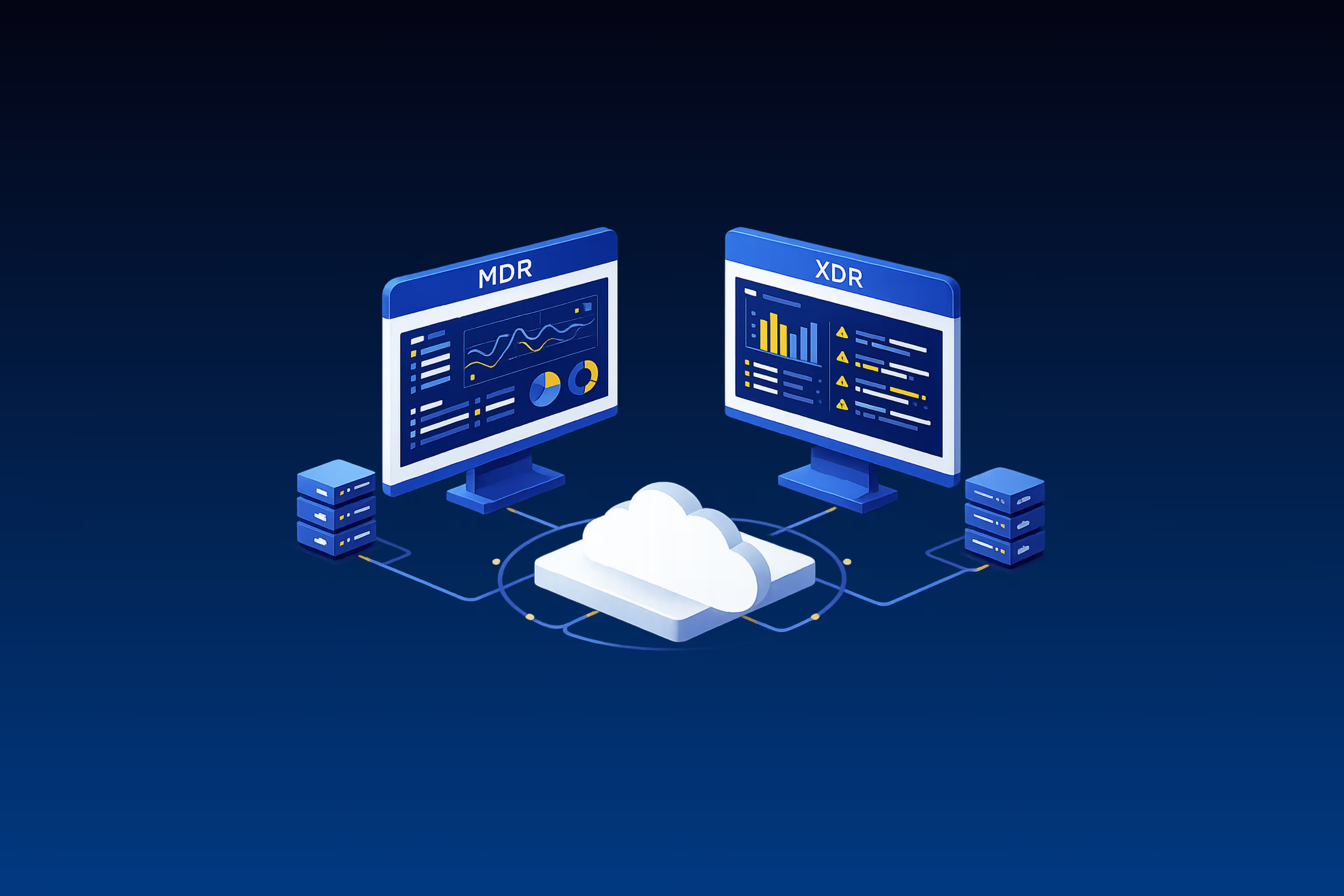
MDR and XDR are not the same kind of thing. XDR is a technology platform. MDR is a managed service. Comparing them directly is like comparing a car engine to a chauffeur. Yet most vendors lump them together because the acronyms sell.
A more useful framing of MDR vs. XDR looks at how the two work together, whether your team can operate XDR without a managed service behind it, and which MDR architecture fits your environment.
If your environment runs across cloud providers, SaaS applications, and identity systems, getting this wrong means gaps in coverage, wasted tooling budget, or a team drowning in alerts that someone else should have resolved.
TL;DR:
- XDR (Extended Detection and Response) is a technology platform that unifies telemetry across endpoints, cloud, identity, and network into a single detection pipeline.
- MDR (Managed Detection and Response) is the managed service layer that delivers investigation and response outcomes on top of those tools, around the clock.
- They operate at different layers, which makes them complements. The real decision is how much of the work your team keeps and how much it hands off.
- Team size moves that line more than technology preference does. Lean teams get further with a service; teams with detection engineering capacity get more out of owning the platform.
- Coverage has to reach cloud APIs, identity (including non-human accounts), and SaaS, not only endpoints.
The Core Difference Between MDR and XDR
XDR (Extended Detection and Response) is a technology platform. MDR (Managed Detection and Response) is a managed service, meaning people and process on top of tools.
XDR emerged as an extension of endpoint detection and response, widening detection beyond endpoints into identity, cloud, and network telemetry. Although it ingests security data from multiple sources, it remains EDR-centric in design.
MDR is an outsourced service that owns investigating agreed-upon alerts and, in some cases, takes action per agreement with the customer. Traditional MDR runs that work through human analysts and deterministic playbooks. AI-native MDR uses agentic investigation to assemble context and reach a verdict. The architecture, more than the label, determines what your team receives.
Because the categories answer different questions, a like-for-like feature scorecard tends to mislead. The table below compares what each one gives you.
The right-hand column describes capacity, not technology. What you buy from an MDR is someone else's ability to finish the work, and the detection stack underneath is often the same one you would license yourself. Most MDR providers operate an XDR or EDR platform as part of their own delivery model, which is why the categories get confused so easily.
How XDR Works in Modern Security Environments
XDR collects and correlates security data across multiple technology layers:
- Endpoints
- Networks
- Cloud workloads
- Identity systems
- SaaS applications
Without XDR, your team stitches together alerts from CrowdStrike, AWS GuardDuty, Okta, and an email security tool by hand. An XDR platform pulls the same telemetry into one detection pipeline.
It correlates a suspicious login from an unfamiliar IP with unusual cloud API calls and abnormal endpoint behavior, surfacing a single investigation in place of three disconnected alerts.
For cloud and hybrid infrastructures, this matters because your attack surface is not static:
- Containers spin up and terminate in seconds
- Serverless functions exist only during execution
- Developers provision new cloud resources daily
Security tools designed for persistent endpoints and predictable network boundaries struggle to keep pace with that churn.
API-driven integration with providers like AWS, Azure, and Google Cloud extends XDR coverage automatically to newly provisioned infrastructure. Agentless monitoring reaches ephemeral workloads where installing a persistent agent is not practical.
Correlation across layers is also what catches a compromised identity moving laterally through cloud services and SaaS applications, since each step on its own tends to look unremarkable.
How MDR Works on Top of Your Detection Tools
A provider owns everything that happens after an alert fires. What has changed is that the market now runs different architectures behind the same three letters, and the architecture decides what lands on your team's plate.
The mechanics of the handoff are consistent across providers:
- EDR or XDR platforms generate initial alerts through behavioral analysis and threat intelligence
- The provider validates those alerts, filters false positives, investigates with telemetry and business context, and orchestrates response actions
What differs is what happens when an alert does not resolve cleanly.
In Traditional MDR, human analysts make the judgment calls, working through deterministic playbooks during their shifts. When an alert does not match a predefined pattern, it often gets escalated to your team with log data attached, and your team investigates it anyway. The operational burden lands back with you.
In AI-native MDR, the platform assembles telemetry, organizational, and historic context, investigates, and reaches a verdict. Human reviewers take the cases that genuinely need judgment. Context assembly is what makes this work: a suspicious login at 2 am means one thing for a traveling sales rep and something else entirely for a terminated contractor. The technology sees the login. A sufficiently context-aware system understands the person, their patterns, and whether the behavior is normal for them.
A third approach sits alongside both, and it is not a kind of MDR. AI SOC tools automate triage and investigation, but your team runs them, owns the response, and keeps the accountability. Underneath the acronyms, the decision is about who is on the hook when an investigation stalls: your team with tooling, your team with help, or the provider. If you are weighing that ownership question directly, the MDR service model is the place to start.
Cloud and Hybrid Requirements: What Actually Matters for Your Security Stack
Organizations with cloud environments face security problems that older MDR and XDR designs were not built to handle. Most mid-market enterprises run a mix of cloud and on-premises infrastructure, and the space between what legacy tooling covers and what these environments demand is where threats find room to operate.
The capability areas below are where coverage most often falls short.
Multi-Cloud API Integration
Cloud provider APIs (AWS CloudTrail, Microsoft Defender for Cloud, Google Security Command Center) expose activity that agent-based approaches alone rarely reach in dynamic environments. Without integration at that level, security tooling has limited visibility into the infrastructure control plane, which is where a great deal of cloud attacker activity plays out.
Treat this as a baseline requirement and confirm it early in any evaluation.
Kubernetes Monitoring Across the 4 C's
Namespace-level visibility, RBAC monitoring, pod security oversight, and API server tracking are where a container intrusion becomes observable. The industry frames this as the 4 C's, covering the Cloud, Cluster, Container, and Code layers.
Managed Kubernetes platforms follow a shared responsibility model: the platform secures the underlying infrastructure, and customers secure their containers and applications. Your MDR or XDR coverage needs to account for your side of that line.
Serverless Security Coverage
Functions in AWS Lambda, Google Cloud Functions, and Azure Functions are short-lived, stateless, and event-triggered, which makes them difficult for runtime tools built around persistent hosts to observe. Dedicated serverless controls remain uncommon in practice.
If your stack cannot see what happens inside a function's brief execution window, that window is a coverage gap an attacker can work in.
Identity Integration as an Attack Path
Identity has become one of the most heavily targeted layers in cloud environments, and non-human accounts (service accounts, APIs, AI agents) now often outnumber human ones. Both point in the same direction for coverage.
Your solution should correlate identity telemetry with endpoint, network, and cloud activity, since compromised credentials and privilege escalation are rarely visible from any one of those signals alone.
SaaS Coverage Through the Identity Layer
Monitoring authentication events, authorization decisions, and user behavior surfaces anomalous access across a SaaS portfolio without requiring a direct integration with every vendor. The identity layer does most of the work here.
Beyond the technology, companies with cloud environments face organizational realities that shape this decision. Security teams are lean. DevOps often owns infrastructure provisioning and controls the cloud environment directly. Automation carries a lot of the load, and security has to fit into CI/CD pipelines without creating friction that developers route around.
MDR vs. XDR for Different Team Maturity Stages
Your team's size and maturity should drive this decision, not vendor positioning about which technology is superior.
Early-Stage and Lean Teams (0-5 Security Staff)
An MDR-first strategy is usually the only workable option at this size. Operating an XDR platform well means continuous detection tuning, custom correlation rules, response automation, and runbook maintenance across every integrated layer.
A team of two or three people cannot sustain that alongside incident response, compliance work, and the rest of their actual jobs.
MDR delivers coverage without hiring delays. Building the equivalent in-house typically takes many months and enough staff to sustain genuine around-the-clock operations. For an organization with one or two security staff and a board asking about breach readiness, a service is the realistic path to coverage that holds up.
Many providers offer tiered service levels, so early-stage companies can start with a narrower scope and widen it as they grow.
More Mature Teams (5-10+ Security Staff)
At this stage, owning XDR with selective MDR augmentation often works better. The organization has established security operations processes, documented procedures, and detection engineering capability.
XDR gives that team direct platform control, custom detection logic tuned to their environment, and institutional knowledge that outlasts any individual employee's tenure.
The hybrid split is usually the practical one. Your team operates the XDR platform during business hours for specialized detection and daytime work, while the provider covers off-hours monitoring and the alert volume that would otherwise consume your team's capacity for strategic projects.
One thing to pin down in either arrangement: proactive threat hunting sits outside standard MDR scope with most providers, including Daylight. Price it as its own service; it is rarely bundled.
Where the Investigation Burden Should Sit
Posed as XDR vs. MDR, this reads like a product choice. In practice, XDR is the detection platform and MDR is the service that investigates and responds to what that platform surfaces. Most teams need both in some form, and the live question is the ratio.
Your team's size sets that ratio. Your environment's complexity across cloud, identity, SaaS, and hybrid infrastructure sets the coverage requirements. And the MDR architecture you buy into decides whether cases arrive resolved or land back on your desk, which is the part your team feels every day.
Traditional MDR, AI SOC tools, and AI-native MDR produce different outcomes here, and the architecture matters more than the acronym. AI-native providers assemble telemetry context, organizational context, and historic context, then reason across those sources to reach a verdict, so the work arrives finished.
Daylight Security is a MASS company, meaning it offers managed agentic security services for Security Operations. Its AI-native MDR service was built for agentic investigation from day one. Security experts build the context and detections the platform runs on, and they lead response when a real incident is confirmed. The same architecture carries MDR, threat hunting, and the Agentic Security Data Lake.
Frequently Asked Questions About MDR vs. XDR
What Is the Difference Between MDR and XDR?
The difference between MDR and XDR is that XDR is a technology platform your team operates, while MDR is a managed service that operates on your behalf. XDR unifies telemetry from endpoints, cloud, identity, and SaaS into one detection pipeline. MDR supplies the people, process, and accountability to investigate what that pipeline produces and respond within an agreed scope. Many MDR providers run an XDR platform internally to deliver their service.
Can I Use Both MDR and XDR at the Same Time?
Yes, and many mature security teams do exactly this. XDR provides the detection platform your internal team operates during business hours, while the provider covers off-hours investigation and overflow capacity during high-volume periods. The combination works best once your team has roughly 5-10 security staff and established detection engineering processes to justify owning the platform.
Do I Need XDR if I Already Have MDR?
Not necessarily, because most MDR providers already operate detection and correlation technology as part of their service. Buying XDR on top makes sense when your team wants direct control over detection logic, wants telemetry retained and searchable on your own terms, or plans to bring more of the investigation work in-house over time. If none of those apply, the license adds cost without adding coverage.
How Long Does It Take to Deploy MDR vs. XDR?
MDR typically provides initial coverage within days to months, depending on whether it is a traditional solution or an AI-native one, with full onboarding and value realization taking months. XDR timelines vary just as widely. Installing agents and connecting data sources can happen quickly, but building and tuning detection rules, developing response procedures, and training your team to operate the platform is the real work. Expect months before an XDR deployment reaches operational maturity.
What Should I Ask an MDR Provider About Cloud Coverage?
Ask how many alert types the provider actually initiates an investigation for per integrated tool, rather than how many it ingests. From there, ask what business context (identity, device, HR, location) enters each investigation. Then ask whether the provider can correlate across endpoints, cloud, identity, and SaaS to reach a verdict without escalating to your team, and what share of alerts get closed without your involvement. A provider that can walk you through the full investigation path, not just the verdict, is demonstrating investigation quality instead of describing it.
Is MXDR (Managed XDR) the Same as MDR Plus XDR?
MXDR is a vendor-specific term, not a distinct category. Some providers use it to mean "we manage our own XDR platform for you." Others use it to mean "we operate on top of your existing XDR." The label tells you very little on its own. Evaluate what the provider investigates, what response authority it holds, and whether it can demonstrate investigation quality in your environment during a proof of concept.