Top ReliaQuest Competitors and MDR Alternatives in 2026

.avif)
ReliaQuest built its reputation on a practical idea: keep your existing security tools, connect them through GreyMatter, and get unified visibility without ripping anything out. For many enterprise teams, that overlay model was the right call. It preserved existing investments and gave leadership a single operational layer across a fragmented stack. So why are security leaders evaluating ReliaQuest competitors?
The reasons are specific: how long detection tuning takes, alerts that keep coming back, and whether an additive layer still fits an environment that has moved to cloud and identity. None of that is a judgment on ReliaQuest. It describes what the overlay model does and doesn't do well, and if those tradeoffs don't fit where your environment is heading, it makes sense to know what else is available.
This guide covers ten alternatives across different MDR architectures. For each, we cover what the service does, where it fits, and where it falls short.
TL;DR:
- The MDR market has split into three categories: Traditional MDR, AI SOC, and AI MDR. Each carries a fundamentally different accountability model, and confusing them leads to mismatched procurement decisions.
- ReliaQuest's overlay model is structurally additive. GreyMatter sits on top of existing SIEM and EDR spend, and tuning what it detects has historically meant waiting on ReliaQuest.
- Investigation depth per integration matters more than integration count. A provider that covers most alert types for your critical tools will often outperform one with broad integration coverage that investigates only a narrow set of alert types per tool.
- AI MDR is where current market demands are heading, but capabilities vary widely across providers. Contractual accountability, investigation transparency, and response authority separate marketing claims from operational reality.
Key Pain Points Driving Buyers to ReliaQuest Competitors
ReliaQuest sells GreyMatter, and its recent work has gone into the platform: role-based "agentic teammates" first, then in July 2026 a SIEM-less detection path that inspects data at the source and in transit, plus AI-driven red teaming. The August 2026 release extended the teammate line into operational technology and added more than 70 new data sources. Weighing ReliaQuest MDR against the market therefore means comparing a platform-plus-service model with a managed contract, and the complaints that surface in those evaluations cluster in the same places.
First, detection customization has historically been locked behind ReliaQuest's team, and custom detection delivery is often slower than represented in pre-sales, which means your coverage gaps persist until the queue clears. ReliaQuest has begun moving that work into an agentic workflow where an agent drafts and tunes rules and a person approves them, so this one is a moving target worth testing against your own backlog.
Second, alerts that should be resolved silently still surface in the console without learning from prior resolutions. That points to a deeper architectural issue: without structured context capturing why a verdict was reached and what "normal" looks like in your environment, the platform keeps re-triaging what it should already know. This is the alert fatigue problem in its most expensive form.
Third, onboarding and integration complexity hits lean teams hard. Running the overlay alongside existing tools creates its own friction: alerting levels that need recalibration, events that should have been remediated silently, response times that slip.
The overlay model's core tradeoff is that it adds a layer without replacing anything. If that layer doesn't reduce your team's operational burden in practice, the additive cost becomes hard to defend.
Evaluation Framework for ReliaQuest Competitors
The dimensions below separate vendors who have thought through the operational reality from vendors who have thought through the pitch.
- Coverage breadth: Does the provider cover your actual stack (endpoint, cloud, identity, SaaS, and email) or only a subset? Get specific about which tools and which alert types.
- Integration depth and directionality: Does the integration read only, or can it write back? And of everything it pulls in from a given tool, how much initiates an investigation? The gap between "we integrate with Wiz Defend" and "we investigate most Wiz Defend alert types" is where real coverage differences hide.
- Investigation scope: Does the provider investigate every alert to resolution, or handle the lower-complexity cases and hand back the rest? Escalation volume is the clearest signal.
- Response authority: What can the provider do autonomously, and what needs your approval? Pre-authorized containment is meaningfully different from a notification that something looks suspicious.
- Transparency: Can you see how a decision was made, including the data used and the logic applied? Glass Box and black box operations separate the moment you want to challenge a verdict.
- Expert caliber: Who is behind the service, and are they senior enough to lead an incident response engagement?
- Investigation triggers: Does the provider only investigate alerts from your existing tools, or also findings surfaced through proprietary rules on your log data? A provider that depends entirely on your tools for signal inherits whatever gaps those tools have.
No single provider wins on every dimension. The goal is to know which ones matter most for your environment before you start the conversation.
Top ReliaQuest Competitors to Know in 2026
The ten providers below span the three architectures named in the summary above. The table is a directional read and the profiles beneath it carry the context that matters. Packaging and naming reflect September 2026 and move quickly, so confirm the detail with each vendor.
Investigation triggers and response capability carry most of the weight in that table, and they are what the profiles below spend the most time on.
1. Daylight Security (Managed Agentic Security Services / MASS)
Daylight's architecture answers the complaint that drives most ReliaQuest evaluations: an overlay that adds cost and complexity without reducing the investigation work landing on your team. Daylight and ReliaQuest differ most on where investigation ownership sits: ReliaQuest coordinates the tools your team still operates, and Daylight takes the investigation itself.
Daylight is a MASS company, meaning it offers Managed Agentic Security Services for security operations. It takes ownership of investigation and response under a defined accountability model: AI agents investigate alerts with full context assembly, and security experts build the knowledge architecture that makes those investigations accurate and auditable.
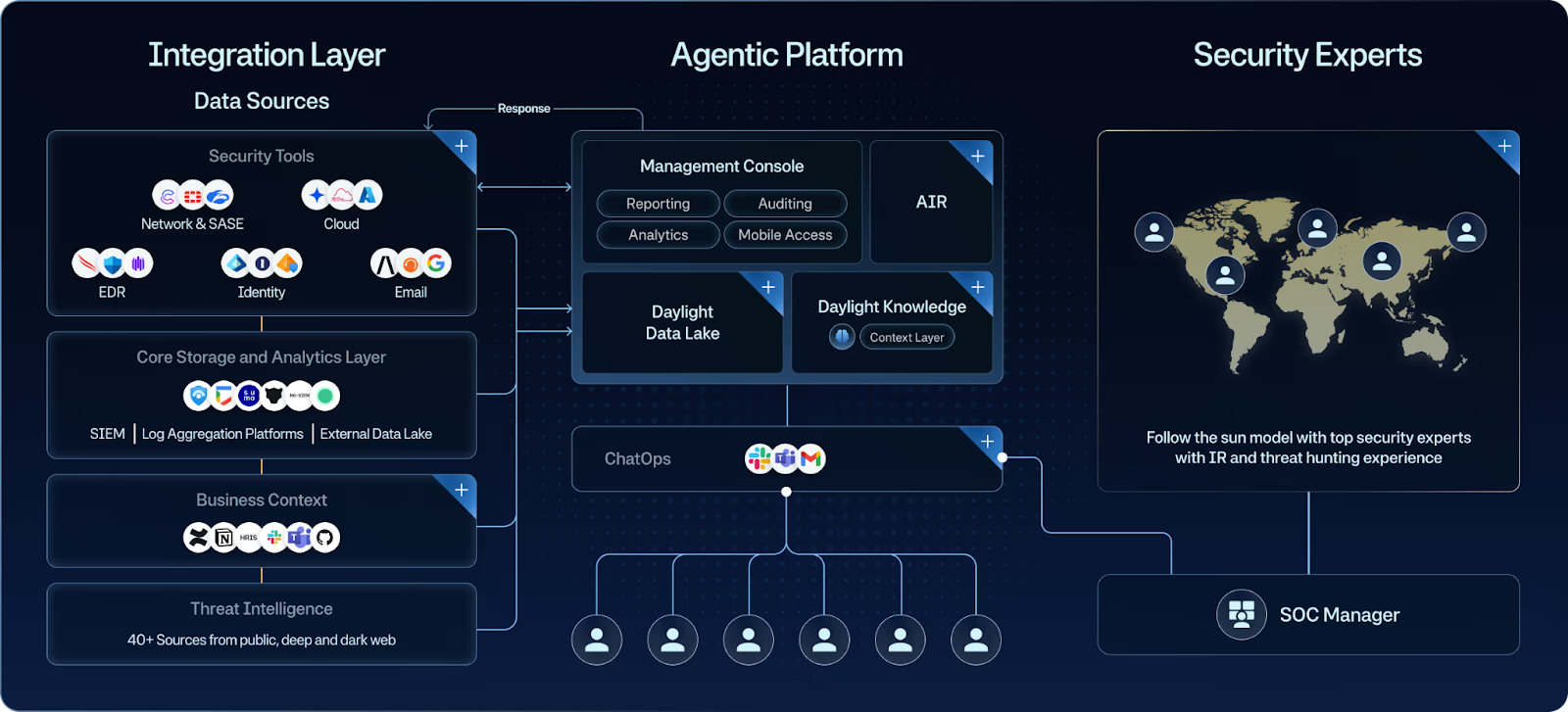
Each pain point above maps onto a specific piece of that architecture. Detection customization queues matter less when Daylight runs proprietary detection rules on your streaming log data, generating a second stream of investigation triggers independent of your tools' alert coverage. Deep, bi-directional integrations take on the resurfacing problem: they cover the majority of alert types per tool and write back to close resolved issues at the source, so your dashboards stay accurate as items close. And investigation opacity gets replaced by what Daylight calls Glass Box transparency: every decision is visible and auditable, showing what was checked, what data was used, and what conclusion was reached.
Underneath that sits Daylight Knowledge, a customer-specific context repository that builds continuously, pulling telemetry, organizational, and historic context together for each investigation, so cases that look ambiguous on partial context tend to become deterministic on full context. Security experts with incident response and threat hunting backgrounds do that context building, along with low-confidence verdict review and incident response leadership.
Daylight is not the right answer everywhere. Teams running less than half their infrastructure in the cloud, organizations that need a fully on-premises deployment, mature in-house SOCs looking for a co-managed arrangement, and buyers whose main criterion is the lowest price are all better served elsewhere.
Best for: Mid-market to enterprise organizations with significant cloud environments, particularly teams replacing an overlay model who want managed investigation depth, contractual accountability, and a real reduction in re-triage volume.
2. CrowdStrike Falcon Complete (with Charlotte AI)
Falcon Complete is CrowdStrike's managed detection and response service, built directly on the Falcon platform and now marketed as agentic MDR. It extends CrowdStrike's endpoint, identity, and cloud protections with 24/7 monitoring, investigation, and remediation handled by CrowdStrike analysts working alongside Charlotte AI, which the company now positions as an agentic analyst.
CrowdStrike builds the service around Falcon telemetry, so investigation depth and response quality scale with how much of your environment Falcon covers. Third-party sources can be brought in, and CrowdStrike has added certified data pipelines for feeding them into its own SIEM, but the correlation story still starts from Falcon.
Best for: Organizations standardized on CrowdStrike that want MDR tightly integrated with their EDR/XDR stack.
3. Arctic Wolf MDR
Arctic Wolf is a managed detection and response provider built to deliver a largely outsourced security operations function, primarily for mid-market organizations. It pairs its own platform, now marketed as the Aurora Superintelligence Platform, with an assigned "Concierge Security Team" of named experts who act as an extension of your internal staff. Since acquiring Cylance's endpoint assets it also sells its own endpoint line, so the question of whose agent runs on your machines is worth settling early.
The cloud picture has moved too. Open XDR integrations, a cloud detection and response line, and a Wiz partnership all make the older read of Arctic Wolf as an on-premises and hybrid fit harder to sustain. The scoping conversation has not changed: cloud sources, identity coverage, and log retention are where buyer and vendor assumptions tend to diverge, so get specific on what sits in the base service before signing.
Best for: Organizations that value a relationship-driven model with a named team and broad log coverage, and that are willing to test cloud and identity depth against their own environment.
4. eSentire MDR (Atlas)
eSentire is an established MDR provider running its own platform, Atlas, a name it now uses for its service packages too. It publishes a mean time to contain of under 15 minutes and claims 300+ integrations. The Microsoft alignment is meaningful: eSentire operates Microsoft Sentinel alongside Atlas as a dedicated offering, and that service reaches AWS, Google Cloud, and identity sources too.
The MSSP heritage is worth examining. The operating model has evolved, but verify investigation depth versus alert forwarding for your specific tool stack, because integration breadth does not automatically translate to investigation depth. With 300+ integrations, confirm that cases land with the right response authority and don't create a routing overhead problem in place of an alert fatigue problem.
Best for: Large enterprises running a genuinely mixed stack, particularly where Microsoft security tooling sits at the center of it.
5. Sophos MDR
Sophos MDR runs in two tiers. The base service provides 24/7 monitoring and containment guidance, and the upper tier adds full-scale incident response. Sophos's current service description calls them Sophos MDR and Sophos MDR Plus, while commercial pages still carry the older Essentials and Complete labels, so confirm which package a quote refers to. Sophos reports more than 40,000 MDR customers and nine regional security operations teams.
Following the Secureworks acquisition, Sophos also sells Taegis MDR as a separate enterprise line alongside its own service, so a Sophos evaluation now covers two products. Investigation depth for non-Sophos telemetry can be limited, so a stack spanning several EDR platforms, identity providers, and SaaS tools is worth walking through source by source before you scope the service.
Best for: Organizations wanting fast, predictable MDR, strongest in Sophos or predominantly Microsoft environments.
6. Intezer
Intezer sells an AI SOC platform for enterprise teams, built on its ForensicAI engine. It supports autonomous triage and investigation across endpoint, SIEM, identity, cloud, and reported phishing, and investigation outcomes feed back into detection engineering as a closed loop, so rules get tuned at the source. This is software your team operates, and accountability stays with you.
In 2026 Intezer repositioned itself explicitly at teams outgrowing MDR, which makes it a replacement candidate in a ReliaQuest evaluation.
Best for: Organizations that already have the in-house operators to run a platform and want the triage load automated without moving the work to a provider.
7. Prophet Security
Prophet Security is an AI SOC platform whose AI SOC Analyst triages and investigates alerts, then responds through scoped agent actions that run autonomously or with your sign-off. Alongside it sit an AI Threat Hunter and an AI Detection Engineer that maps coverage against MITRE ATT&CK and authors rules to close the gaps it finds.
Prophet also offers an optional service layer in which its own experts review malicious determinations before they reach you. The platform is still customer-operated, but that layer sits closer to a managed arrangement, so establish what it commits to contractually.
Best for: Organizations that want configurable automation levels with a human check on the decisions that carry weight.
8. Dropzone AI
Dropzone AI is an AI SOC analyst your team operates, with 90-plus integrations across SIEM, EDR, cloud, identity, and email, though you should verify which of your specific products are supported and at what depth.
Its most distinctive capability is user outreach: the platform messages affected users in Slack to confirm activity details and clarify intent, either automatically or subject to approval, depending on how you configure it. Dropzone does not function as a traditional MDR with contractual response obligations, and accountability stays with your team.
Best for: Teams with high alert volume looking for AI-augmented triage.
9. Microsoft Sentinel and Defender XDR
Sentinel and Defender XDR continue to converge in the Defender portal, though that move isn't finished: Microsoft has pushed Azure portal retirement out to March 31, 2027, and parts of the wider Sentinel platform remain in preview. E5 license holders receive up to 5 MB of free data ingestion per user per day.
The managed option is Defender Experts MDR, renamed from Defender Experts for XDR. Its first plan stays inside Microsoft Defender XDR. The second extends expert triage to third-party sources ingested through Sentinel, but it requires Sentinel, and on those sources Microsoft's analysts advise on response actions instead of acting in the third-party product.
Best for: Microsoft-heavy environments with internal SOC capacity to operate the platform.
10. Palo Alto Networks Cortex XDR (with Unit 42)
Palo Alto positions Cortex XDR as the detection and investigation layer for an AI-driven SOC, feeding Cortex XSIAM as the broader platform. It ingests endpoint, network, and cloud telemetry to correlate events, surface incidents, and support guided investigations. Cortex AgentiX, the successor to XSOAR, adds agentic automation across XSIAM, XDR, and Cortex Cloud. It is response tooling rather than an additional source of detections.
The managed option is Unit 42 Managed XSIAM, refreshed in 2026, which runs a 24/7 managed SOC on XSIAM staffed by Unit 42 analysts and bundles incident response hours into the agreement.
Best for: Palo Alto customers wanting native XDR with embedded managed services.
Choosing the Right ReliaQuest Alternative for Your Environment
The vendors in this guide that execute Traditional MDR well do so within the constraints of that architecture. If those constraints match your environment, they are reasonable choices. If they don't, a stronger execution of the same model won't resolve the underlying mismatch. Cloud, identity, and SaaS coverage gaps don't close because the connector layer has more integrations, and re-triage volume doesn't drop because the SOAR playbooks run faster.
So if your frustration is additive cost without workload reduction, swapping overlays won't fix it. The constraint may be the overlay model, and the decision is which architecture suits where your environment is heading. For teams that have hit the limits of the overlay approach, or that evaluated AI SOC tools and found the operational burden stayed with them, AI MDR is the category worth examining, and capabilities vary enough across its providers that the evaluation work still matters. But the starting point is the architecture, not the feature list.
Daylight was built around the failures that drive a ReliaQuest evaluation: investigation opacity, alert re-triage, signal gaps from single-source triggers, and the burden of running an additive layer. It takes accountability for investigation and response outcomes, which is what moves the work off your team's plate.
If you're ready to see what investigation looks like when context drives every verdict, book a demo to see Daylight in action.
Frequently Asked Questions About ReliaQuest Competitors
Does ReliaQuest Sell an MDR Service?
Not as a named service. ReliaQuest's own answer to the question is a comparison page, published in February 2026, arguing that MDR leans too heavily on the endpoint to cover a modern environment, and it markets GreyMatter as the alternative. So a buyer searching ReliaQuest MDR is matching a vendor against a category that vendor has declined to join, which is worth knowing before the quotes arrive, because a platform agreement and a managed-service contract are not scoped the same way.
Is Replacing ReliaQuest Mainly a Tooling Decision or an Operating Model Decision?
Operating model, and it's the half people underestimate. Swapping platforms is a migration with an end date. Changing who owns investigation changes what your analysts do all day, what you hire for next, and who picks up the phone at 3am, and none of that appears on a feature comparison. Settle that question and the tooling shortlist tends to write itself.
What Should I Ask Any MDR Provider Before Switching From ReliaQuest?
Two, and both are about where the work and the risk end up. Can they push containment into your environment, or does the case come back to your team to execute? Then: what can you take with you at contract termination, in investigation history, detection rules and raw telemetry? Providers are rarely equally comfortable with both questions, and the one they dodge tells you which way the relationship is built.
What Should Matter More Than a Long Integration List?
What the list is actually counting. An integration usually means a connector exists and data arrives, which tells you about the provider's engineering backlog. It says nothing about your coverage. The number that changes your week is how much of that data gets investigated, and providers rarely publish it, so you have to ask.
What Is the Practical Difference Between AI SOC and AI MDR?
Liability, mostly. An AI SOC tool triages and investigates, but your team runs it and owns whatever it misses, with no contracted response behind it. An AI MDR provider operates the service and carries obligations for investigation and response outcomes. The two can run comparable automation underneath, and only one of them owes you a result.