What Is MDR? How Managed Detection and Response Works

.avif)
Your MDR should contain threats and close incidents, not feed your team more alerts to triage. That's the promise of Managed Detection and Response (MDR): a provider that owns the investigation lifecycle and takes security events through to resolution. Whether it delivers depends entirely on how the service is built.
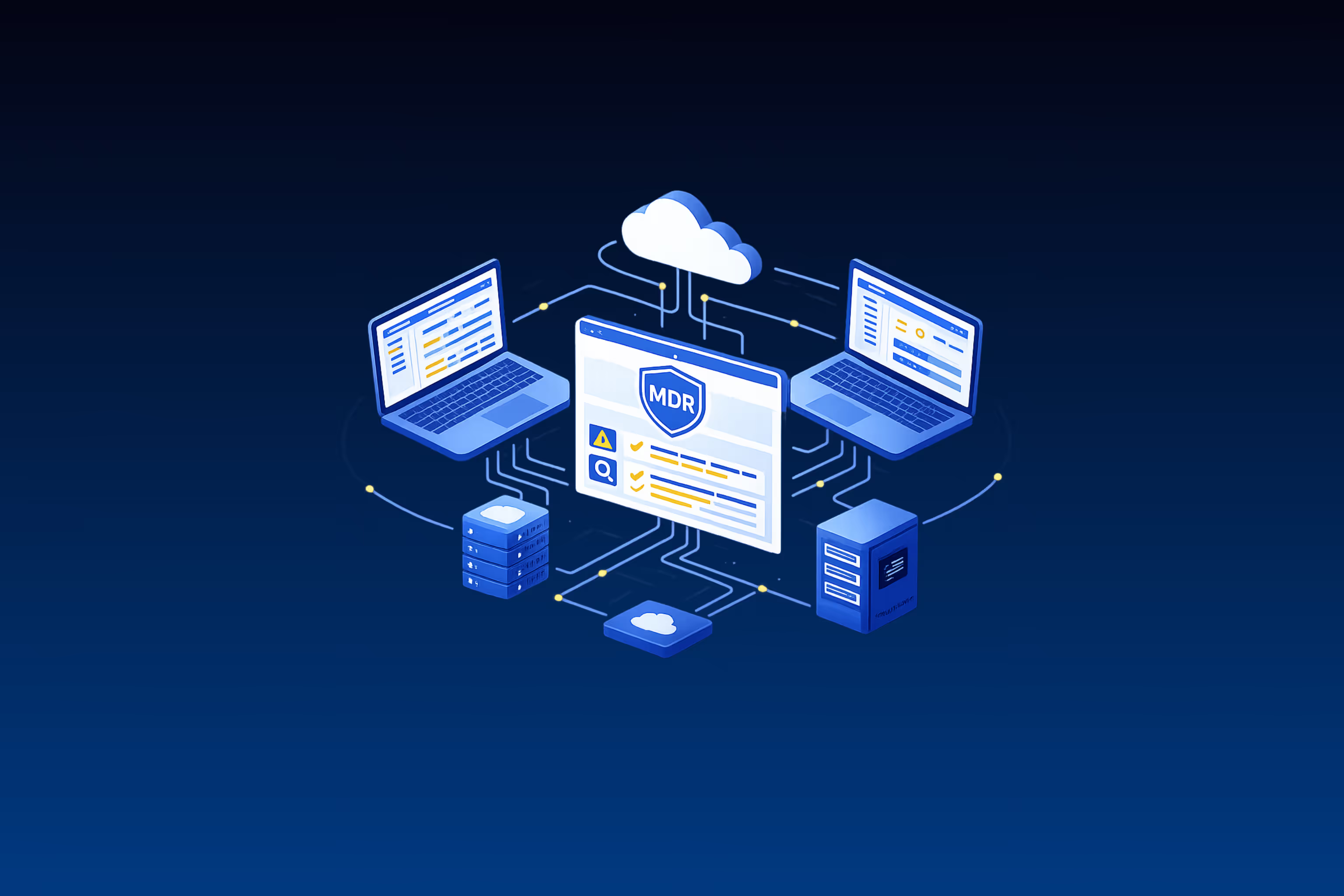
MDR is a managed security service that owns investigating agreed-upon alerts and, in some cases, takes action per agreement with the customer. It escalates an investigation when it cannot complete it or when it confirms a real threat. In practice, an MDR extends the customer's security team.
Without a working MDR, alerts pile up over weekends, investigations stall because nobody has enough context, and engineers hired to build detections spend their days triaging instead. MDR exists to solve these problems.
TL;DR:
- MDR is a managed security service that owns investigation and response outcomes 24/7/365
- MDR coverage scope depends on the provider, the customer's environment, and the contract
- MDR engagements tend to break down on alert fatigue, black box operations, and coverage gaps
- Threat hunting, incident response, and DLP investigation usually sit outside the base MDR contract
- The market has matured enough that security leaders don't need to settle for a service that generates more work than it absorbs
- The questions worth asking are whether a provider can integrate across your full environment, complete most investigations without escalating, and show its work well enough that your team learns from it
Managed Detection and Response, Defined
An MDR provider monitors your alerts around the clock, investigates the ones you have agreed on, and either closes them or brings them to you with the work attached. The definition is narrower than the acronym suggests. Detection tooling generally stays yours, though some providers also run their own rules on your data, and response authority depends on what the contract grants.
When MDR works, threats get contained and incidents get closed, so the ticket queue stays manageable.
The label covers several distinct operating models, though. Providers differ on who runs the investigation, how much of it completes without your involvement, and who is accountable for the outcome. Traditional MDR, AI SOC platforms, and AI-native MDR each answer those questions differently, and the answers matter more than any feature list.
What MDR Usually Covers, and What Sits Outside It
Scope is worth reading closely, because contracts often cover less than buyers assume. The table below maps what typically falls inside the base service and what tends to be quoted as its own line.
A narrower scope can still be a good deal. An unexamined one tends to get expensive, which is why MDR pricing conversations belong alongside a written scope.
How MDR Works in Modern Security Environments
An MDR engagement moves an alert through detection, triage, investigation, and response. Detection sits upstream of the service itself, arriving from your security tools and from any rules the provider runs on your data. The quality of each phase determines whether your team gets outcomes or more work.
Where MDR Investigations Start
MDR investigations are typically triggered in two ways: security tool alerts and custom detection rules. Alerts originate from security tools such as EDR, XDR, or cloud detection and response (CDR). Those tools produce the signal; the MDR owns what happens next, which is the line that separates EDR from MDR. Detection rules identify suspicious activity by querying logs and telemetry across systems.
Some organizations maintain their own detection rules in platforms like SIEM. Supporting those detections is a valuable MDR capability, but it is operationally complex enough that some providers keep it out of scope.
The strongest MDR services initiate investigations from both sources: alerts generated by security tools, and findings produced by detection rules running across customer telemetry. This dual approach improves visibility and reduces the likelihood that meaningful activity is missed.
Alert Triage and Investigation in MDR
After a detection fires an alert, the MDR team decides whether it warrants investigation. This step, called triage, uses alert severity, metadata, and basic enrichment to route the alert. Triage cannot tell you whether the activity is a real threat.
Alerts that pass triage move to investigation. During investigation, analysts gather additional context across systems to understand the activity and determine whether it represents a real threat.
This typically requires several kinds of context. Telemetry context comes from logs and security tools. Organizational context covers the policies, exceptions, and unwritten rules specific to the company. Historic context comes from documenting what past investigations concluded and why.
Every investigation should end with a verdict: benign activity or confirmed malicious behavior. When the provider lacks sufficient context to reach one, escalation becomes the default, and the alert is forwarded to the customer for further analysis.
MDR Response and Containment
Once an investigation confirms malicious activity, the next step is containment. Typical response actions include isolating endpoints, disabling compromised accounts, revoking sessions, or blocking malicious domains and infrastructure.
An important distinction between MDR providers is whether they execute these actions directly or only recommend them. Some services stop after investigation and send the customer a ticket with recommended remediation steps. Others operate with pre-approved response authority and can take immediate containment action.
Effective MDR services focus on stopping the attacker's ability to move or persist, while giving the customer clear documentation of what happened and what was done about it. The internal security team then leads longer-term remediation and recovery.
Benefits of MDR for Security Leaders
When MDR works as intended, operational burden lifts off your team, alert backlogs shrink, and confirmed threats get contained faster.
Operational Efficiency That Frees Strategic Work
When alert handling fills the week, strategic projects roll forward quarter after quarter.
A well-functioning MDR reduces that burden. By handling alert triage and investigation around the clock, the service absorbs the repetitive investigation work that would otherwise fall on the internal team.
With continuous coverage in place, security teams get their time back to improve detections, strengthen controls, and work on the risks that actually threaten the business.
Alert Backlogs That Do Not Wait for Monday
Many security teams struggle with alert backlogs. Alerts accumulate overnight, over weekends, or when internal teams are busy with other priorities. Important signals can sit in queues for hours or days before anyone has time to investigate them. In practice, teams often review only the critical and high alerts.
A working MDR investigates alerts continuously. With around-the-clock work, alerts do not wait for the next available engineer. Each one is triaged and investigated as it arrives, so potential threats are evaluated quickly.
The benefit is confidence that meaningful activity is not sitting unnoticed while the internal team is focused elsewhere.
Faster Containment of Real Threats
The speed at which a threat is contained often determines whether an incident stays limited to a single system or spreads across the environment.
Effective MDR services operate with pre-agreed response actions that let them contain threats quickly, often before the internal team has been paged. Containment at that stage limits how far an attacker can move.
This reduces dwell time and limits the potential impact of an incident, while giving the internal team the information and evidence needed to complete remediation and recovery.
Common MDR Misconceptions Security Leaders Should Avoid
The assumptions below tend to lead to poor purchasing decisions, or to engagements that quietly stall a few months after onboarding.
Assuming MDR Replaces In-House Security Staff
MDR is a partnership. It extends and elevates your team without replacing it. Internal security teams retain responsibilities providers can't fulfill: understanding organizational priorities, owning remediation decisions, and integrating findings into broader security strategy.
Buying MDR as a Compliance Checkbox
A common failure mode is buying MDR to check a box. The provider deploys generic rules, alerts arrive without organizational context, the internal team starts ignoring them, and the partnership degrades to maintenance mode.
Evaluating MDR Providers on SLAs Alone
SLAs measure response time. They say little about investigation quality or business impact, and a provider can meet every SLA while delivering low-value alerts with minimal context.
Better indicators include alert quality, investigation depth, and how well the service integrates with broader security strategy. Ask to see how verdicts are reached and what evidence supports each conclusion.
Assuming AI Either Replaces Analysts or Changes Nothing
The conversation about AI in MDR tends to collapse into a dead end. Either AI will replace human analysts entirely (it won't), or AI is just a faster way to run the same playbooks (it shouldn't be).
The more useful distinction is architectural. Bolting AI onto an established investigation workflow speeds up individual steps, but the workflow itself stays the same: detect, triage manually, escalate what's ambiguous, wait for a human to pull context. The analyst has to know the environment either way, and the escalation lands on your desk.
AI-native MDR works differently. When the investigation engine is built around agentic reasoning from the start, the AI assembles telemetry, organizational, and historic context before an analyst ever touches the alert. As a result, fewer alerts need human judgment.
MDR Is Evolving, and the Architecture Question Matters
Early on, MDRs solved a staffing problem. Organizations that couldn't hire enough analysts outsourced monitoring to a provider with a 24/7 team. The model worked for its era: perimeter-centric environments, predictable alert patterns, and human analysts who could learn customer environments over months.
That model is hitting structural limits with modern environments:
- Cloud environments distribute data across dozens of services
- Identity-based attacks often don't trigger endpoint alerts
- Collaboration and development tools generate security-relevant signals that older MDR architectures were never built to ingest
The attack surface expanded, but the investigation model stayed the same. Many established providers responded predictably:
- Add AI as an acceleration layer on top of existing workflows
- Triage faster
- Enrich alerts automatically
- Route recommendations to analysts who still make the final call
These improvements are real, but they don't change the underlying constraint. The analyst still needs to understand your environment, the investigation still follows a linear workflow, and escalation is still the default when a case is ambiguous.
The market response has split along operating model and accountability.
Traditional MDR
Traditional MDR continues with human-led investigation, SOAR-augmented workflows, and shift-based coverage. These providers were built for perimeter-era threats, and they do investigate alerts and take response action within an agreed scope. They have added AI to accelerate existing processes without changing the fundamental architecture. Escalation volumes tend to run higher as a result, and cases spanning cloud and identity are often where the model shows its limits.
AI SOC
AI SOC platforms automate alert triage and investigation. They are tools you operate, not managed services. The customer runs the platform, retains accountability, and makes the final call on every escalation. It offers no response guarantee, and the provider assumes no liability. For organizations with skilled operators, they reduce noise; for teams without that bench, the work lands back on the team.
AI-native MDR
AI-native MDR is a fully managed service built on an AI-native architecture. The provider investigates and responds with accountability for outcomes, and an AI-native MDR contract can carry breach liability for the investigation work, on terms specific to that contract rather than the category. Agentic investigation assembles context across systems, resolves cases autonomously where the evidence supports it, and routes complex or ambiguous cases to human reviewers. Capabilities and maturity vary from one provider to the next. It is also the direction the market is heading, and the standard worth measuring the others against.
The distinction matters because the architecture determines the outcome. Retrofitting agentic investigation onto a platform built for linear, human-led triage rarely works. The architecture has to be designed for it from the start.
How to Tell MDR Providers Apart
The evaluation that separates providers is where the investigation burden sits: with your team, shared, or fully owned by the provider. The questions below get you most of the way there.
Can the provider use data across endpoints, cloud, identity, and SaaS to investigate alerts end-to-end and reach a clear verdict without escalating to your team? A good answer names the specific telemetry it correlates and the write-actions it can take. An evasive answer stops at "we integrate with your SIEM" or "we monitor all your logs," which describes data collection and says nothing about who reaches the verdict.
How are alerts actually resolved, and what proportion are fully investigated and closed without customer involvement? Watch for the answers at either extreme. "Our AI resolves everything" is not credible, and "we investigate every alert manually" is not achievable at volume. What you want is a clear account of which cases complete autonomously and which reach a person, and why.
Transparency is worth pressing on too, and it is the easiest to test. Any provider claiming AI-driven investigation should show you the reasoning, the data sources, and the logic behind each verdict: exactly what was checked, what data was used, and how the conclusion was reached. A summary report is not the same thing, and "our logic is proprietary" is an answer in itself. Comparing MDR providers on these terms separates them faster than any checklist.
Daylight is a MASS company, meaning it offers managed agentic security services for Security Operations. Its MDR service is where that model starts.
Frequently Asked Questions About MDR
What Does an MDR Service Include?
At minimum, an MDR service investigates an agreed set of alert types and reports verdicts back to you. Beyond that, scope varies: some contracts include response authority, others stop at recommendations, and threat hunting, incident response, and DLP investigation are commonly quoted as separate lines. Get the alert types, the response authority, and the exclusions written down before signing.
How Long Does MDR Onboarding Typically Take?
Onboarding time varies by provider and by the complexity of the environment. Some providers require months of integration work before monitoring begins.
Others can start ingesting telemetry within days, then need time to build organizational and historic context before investigations reach full quality. Ask providers to be specific about what "onboarded" means: is it data flowing, or confident investigations running?
What Data Does an MDR Provider Need Access To?
It needs the alert sources it will investigate from, plus the systems that explain what those alerts mean. The first group is usually EDR, the identity provider, cloud audit logs, and any SIEM in place. The second group is what turns an escalation into a verdict. It includes HR and directory data showing whether a user is still employed and what their role is, device management showing which machines are managed, and collaboration and code platforms, which generate security-relevant signals of their own. Ask each provider which of these it reads and which it leaves out.
Is Threat Hunting Part of MDR?
Usually not as a standing activity. Most providers offer indicator sweeps when a known threat is active, and many will run them as part of an MDR engagement. Hypothesis-based threat hunting, where an expert forms a thesis about adversary behavior in your specific environment and tests it, is generally a separate service with its own scope and cadence. If it matters to you, confirm the provider offers it; don't assume MDR covers it.
What Should We Look for When Choosing an MDR Provider?
Integration across the environment you actually run, transparency into how verdicts are reached, and how many investigations finish without landing back on your team. Underneath all three sits the same question of where the investigation burden ends up, which is why SLAs on their own tell you so little about investigation quality.