Managed Cloud Security vs On-Prem: Key Differences
.avif)
.avif)
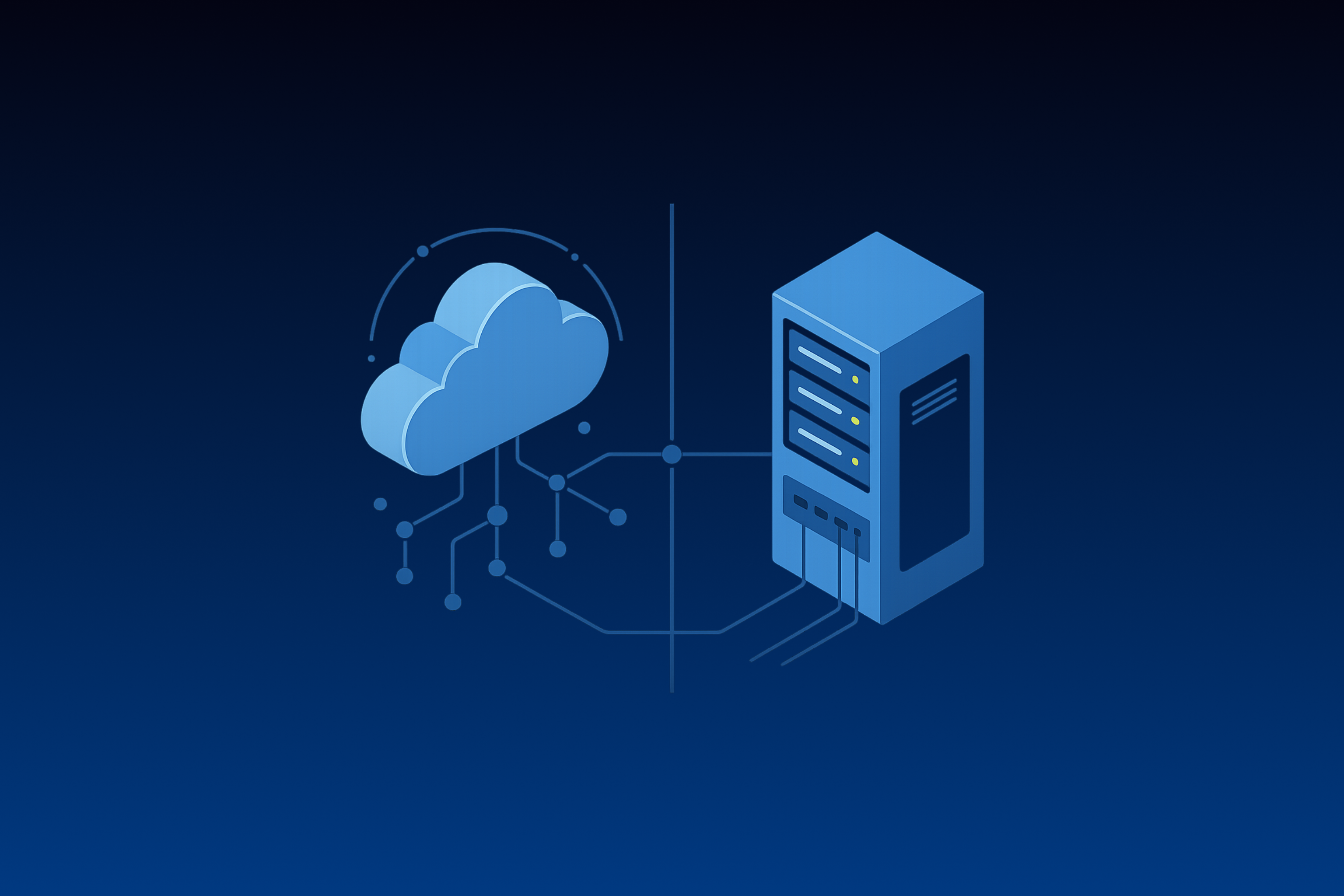
The managed cloud security versus on-premises comparison collapses two separate decisions into one. Deployment location determines which systems exist and what telemetry they produce. Operating ownership determines who investigates that telemetry when something fires. Infrastructure may sit on premises, run in the cloud, or span both. Security operations may be internal or managed, with co-managed arrangements dividing the work.
Keeping those axes apart matters because the evidence modern intrusions leave has moved. A stolen access key used through a cloud provider's API can clone a production database without creating a malicious server process or dropping a file, so a detection program built only around endpoints may have nothing to fire on regardless of who staffs the SOC. Hybrid estates are now common, and workloads move both ways between public cloud and on-premises environments. The comparison worth making is therefore between two operating models: security operations that still treat the host as the crime scene, and operations built to investigate control-plane, identity, and SaaS activity at the speed attackers now move.
TL;DR:
- The crime scene moved from the host to the control plane. Modern intrusions can be identity- and API-driven and leave no endpoint artifact, and endpoint tuning rarely closes a gap that sits at the design level.
- Attacker speed has outrun shift-based operations. Access handoffs can happen in seconds, and the off-hours window is exactly where in-house staffing economics break for many mid-market teams.
- Compliance rarely mandates on-prem. SOC 2, HIPAA, PCI DSS, and GDPR permit managed cloud models with the right controls and contracts; defense and law-enforcement frameworks can impose genuine sovereignty or personnel constraints, though specialized cloud environments may still satisfy them.
- The decision depends on operating conditions. Staffing feasibility, detection IP, regulatory scope, and SLA enforceability decide the operating model, while deployment location determines which systems and telemetry must be covered.
Where the Two Models Diverge
Deployment and ownership produce several valid combinations. An organization can run cloud security in-house, outsource monitoring for on-premises systems, use a managed service across a hybrid estate, or divide responsibilities through a co-managed model.
"Managed cloud security" here means outsourced monitoring, investigation, and response delivered as a service across cloud, identity, SaaS, and endpoint telemetry. "On-prem" refers to systems deployed in facilities the organization controls. For the operating-model comparison below, "in-house" means your SIEM, your SOC staff, your shifts, and your detection engineering, whether those operations cover on-premises, cloud, or hybrid systems. Five differences separate the two operating models in practice.
1. The Crime Scene Moved From the Host to the Control Plane
Traditional incident response was built around disk and memory forensics, where an investigator images the host, pulls memory, and reconstructs events from artifacts. In cloud environments, incident response teams reconstruct the attack timeline from CloudTrail, Azure Activity Logs, or GCP Cloud Audit Logs instead of endpoint telemetry. There may be no endpoint to image, logs can expire quickly, and the cloud provider owns part of the stack under the shared responsibility model.
Identity is now a primary intrusion path. Mandiant's M-Trends reporting found stolen credentials had risen to the second most common initial infection vector in 2024. Its UNC3944 reporting shows help-desk social engineering leading to data theft from SaaS applications to attacker-owned cloud storage. Attackers then use SaaS permissions abuse for lateral movement. No endpoint malware signal is required at any stage. EDR agents run on hosts rather than on cloud APIs, identity providers, or SaaS platforms, so EDR alone typically does not reach those evidence sources; these are scope boundaries inherent to endpoint technology. In-house and managed teams alike can investigate them, provided someone collects, retains, and connects the required telemetry.
2. In the Cloud, Evidence Exists Only if Someone Configured It
AWS CloudTrail defaults include management events only. S3 object-level reads and writes and Lambda invocations are classed as data events and stay off unless someone explicitly turns them on, which means that under the default configuration a detection rule for S3 object access has no event to evaluate.
The same dependency governs identity and SaaS evidence, where retention settings, license tiers, and provider capability decide what an investigator can retrieve later. Anything the environment did not collect or retain is generally beyond reach for a retroactive investigation. Federal logging guidance makes the same point about ownership, putting substantial logging responsibility on the tenant in IaaS and more of it on the provider in SaaS.
On premises, an organization sets retention directly, within the limits of its own architecture and budget. In cloud environments, provider defaults and license tiers gate the evidence, and that constraint applies to both operating models: a managed provider or in-house team can only analyze the telemetry available to it. Unmanaged assets, unknown SaaS tenants, and identity systems without sufficient logs create coverage gaps for everyone.
3. Attacker Speed Has Outrun Shift-Based Operations
Attackers can move faster than a shift handover, and API-driven activity in a cloud control plane compresses the window further because no lateral hop needs a host to land on. Threat intelligence reporting on 2025 intrusion timelines found the handoff from initial access broker to secondary threat group had collapsed to 22 seconds, down from more than eight hours in 2022. That leaves little room for alert queues, delayed escalation, or the next scheduled shift.
Timing can compound the problem. An intrusion that begins outside business hours may fall into the period when an under-staffed in-house SOC relies on a junior on-call rotation, if it provides off-hours coverage at all.
4. Around-the-Clock Coverage Costs the Same Wherever Workloads Run
Staffing is where the two axes separate most cleanly. Moving workloads to the cloud, or keeping them on premises, does almost nothing to the cost of covering them at three in the morning. Sustaining true around-the-clock coverage requires enough SOC staff to cover multiple shifts while accounting for leave, training, management, and escalation. For an operating model with those staffing requirements, Daylight's SOC cost breakdown estimates a fully loaded annual cost of $1.5 to $2.86 million. Managed models can share staffing and infrastructure across customers, while an in-house SOC requires the customer to build and mature those capabilities.
Cost is only part of the constraint, and headcount is no longer the sharp end of it. Workforce research now frames the shortage as a skills gap rather than a headcount one, with cloud security among the capabilities teams most often report lacking and roughly a third saying they cannot afford to hire for the skills they need. Federal wage data puts median pay for information security roles well above the broader IT median. Staffing continuous coverage is therefore a structural operating challenge as much as a budgeting one, and the specific capability in shortest supply is the one a control-plane investigation depends on.
5. Response Authority and Accountability Depend on Contracts
In-house, your team holds full response authority and full accountability. On the managed side the spectrum runs from alert forwarding at one end to pre-approved containment at the other, where the provider can quarantine a host, disable an account, or block a connection on your behalf. Market definitions of MDR now treat immediate remote response, preapproved by end users, as a mandatory feature. Contractual protections and response commitments vary by provider, so buyers need to inspect exactly what is covered, what actions are authorized, and what remedies apply when service levels are missed.
When an SLA promises only "reasonable efforts," it may provide little incentive to build the staffing and architecture that consistently hits sub-hour response. Governance does not transfer either, and the CISO remains accountable regardless of operating model.
Those differences compound across the dimensions buyers evaluate, from evidence coverage through accountability.
Quality varies widely inside both columns, so neither structure is better than the other in the abstract. The table describes how each model is built; what a given team gets out of it depends on the implementation.
Compliance Rarely Requires On-Prem
Framework texts allow regulated workloads to use cloud-based security operations. The Trust Services Criteria behind SOC 2 require continuous monitoring for anomalies under CC7.2 but leave infrastructure location and human staffing models to control design; auditors test whether actual practices match documented commitments. HIPAA explicitly permits cloud services under a BAA and imposes no U.S. data residency requirement in the rule text, though other legal and contractual requirements may create residency expectations in practice. PCI DSS v4.0 requires daily automated log review and permits outsourcing, provided you keep third-party service-provider accountability under Requirements 12.8 and 12.9. GDPR's Article 44 governs transfer mechanisms; localization falls outside its mandate, and European regulators publish transfer guidance for organizations working through the mechanics.
Defense and law-enforcement frameworks can impose more restrictive geographic, personnel, authorization, and handling requirements. Those constraints narrow the available managed options and may require specialized sovereign or government cloud environments. Specialized environments can satisfy these constraints without racks owned and operated on the customer's premises. Outside those specialized environments, compliance is usually a contracting and control-design problem, with architecture forming one part of that design.
How to Decide: Six Conditional Criteria
No single recommendation survives contact with the range of estates and teams this decision covers, so the useful output is a set of conditions. Each one below points toward an operating model, and most organizations will match more than one.
- If you cannot fund and retain the SOC headcount for true 24/7 shifts, then in-house around-the-clock coverage is structurally infeasible. Go managed; an on-call rotation leaves a coverage gap at night.
- If your detection logic is proprietary IP or your business generates unusual-but-legitimate signals, then in-house or co-managed models preserve context external providers may struggle to replicate. Co-managed works when the provider operates in your SIEM directly instead of extracting data to its own platform.
- If you are subject to defense, law-enforcement, or other sovereignty requirements, then your managed options may narrow to authorized or sovereign-cloud providers, or you stay in-house.
- If a provider's SLA uses "reasonable efforts" language or the provider cannot name autonomous response actions, then renegotiate or walk. A recommendation-only service lacks pre-authorized containment and leaves response execution with your team.
- If your estate runs across multiple clouds or spans cloud and on-premises systems, then verify purpose-built cloud telemetry coverage before assuming it exists. Attackers can exploit the asymmetry between strong endpoint coverage and weak cloud visibility, so the provider must be able to investigate the cloud control plane, identity systems, and SaaS audit trails.
- If security leadership is strategy-focused and program maturity is still building, then start managed. Retaining internal expertise in investigation, response, telemetry, organizational context, and historic context while outsourcing initial alert handling and 24/7 coverage can preserve control without requiring a full shift-based operation.
A managed SOC does not fix missing logs, weak identity controls, or a stale asset inventory. It surfaces those gaps quickly and rarely compensates for them indefinitely, so the logging fixes in the FAQ below come first regardless of which model you choose.
Why Control-Plane Evidence Changes the Outsourcing Math
Once you decide not to carry the load internally, the work gets done one of two ways. You can buy tooling and run it in-house, or you can hire a managed service that runs the security function for you. AI SOC tools sit on the first path: they automate triage and investigation and return findings, but the customer operates them, executes the response, and keeps accountability for every outcome. Reporting on the 2026 security agenda describes autonomous agents increasingly performing SOC activities such as triaging alerts, investigating activity, isolating hosts, and patching software. That path only changes the staffing math if you already have people to run the tooling.
On the service path, the providers are not interchangeable either. Some traditional MDR services were built around endpoint telemetry and deterministic workflows, with cloud coverage varying by provider. These providers investigate alerts and take response actions within an agreed scope. Their operating model is more human-heavy, so escalation volumes tend to run higher, and in a control-plane intrusion the escalated work lands back with the team that outsourced it. AI-native MDR providers deliver the same managed investigation and response on agentic architecture, though depth varies considerably by provider.
Daylight is a MASS company, meaning it offers managed agentic security services for Security Operations. MDR is the entry point, alongside threat hunting and an agentic security data lake, with phishing, DLP, and AI security investigation delivered as extensions of MDR coverage. Investigations run on telemetry, organizational, and historic context, and they start from either an integrated tool's alert or a proprietary detection rule running on streaming log data. Daylight's security experts build the context and detections behind those investigations and take the complex or ambiguous judgment calls. The service runs as SaaS or hybrid rather than fully on premises, which makes it a poor fit by design for organizations mandated to keep security operations inside their own facilities or running mostly on-premises estates.
Whichever path you take, cloud and identity evidence should decide it. A verdict on a single API call or a token grant requires correlated evidence, which means reading CloudTrail against Entra sign-in events and the SaaS audit trail, then establishing whether the identity behind the call had a legitimate reason to make it. All of that has to happen inside the compressed timelines described above. It is investigation work, and more alerting does not produce it.
Location Sets the Scope; Ownership Sets the Verdict
Treating deployment location and operating ownership as one decision is what makes the managed-versus-on-prem comparison feel harder than it is. Location determines which systems and telemetry must be covered. Ownership determines whether the team covering them can reach a verdict inside the window attackers now operate in. Moving a workload on premises does not buy back investigation capacity, and moving it to the cloud does not create it. Decide the two separately, then test any candidate operating model against the control-plane, identity, SaaS, endpoint, and network evidence your environment produces.
Frequently Asked Questions About On-Premises Security vs Cloud
Does Moving to a Managed Service Mean Giving Up Our Detection Engineering IP?
Not necessarily. A co-managed arrangement, where the provider works inside your SIEM rather than extracting data into its own platform, keeps both the detection logic and the data under your control while still handing off the operational load.
How Do You Test a Provider's Cloud Coverage During a POC?
Ask which control-plane, identity, SaaS, and endpoint alert types initiate a real investigation today, because a supported-integrations list alone does not answer that question. Then confirm the specifics: do CloudTrail data events for your sensitive buckets initiate an investigation, and can the provider correlate them with Entra ID sign-in logs to reach a verdict without escalating routine work back to your team?
Can a Managed Provider Satisfy SOC 2 and PCI DSS Monitoring Requirements?
Yes. Managed SIEM and MDR services can satisfy continuous-monitoring controls, and PCI automated log review under Requirement 10.4.1.1 aligns naturally with managed delivery. Two caveats: PCI outsourcing does not transfer accountability, and SOC 2 auditors can flag a mismatch between documented commitments and actual practice.
What Logging Should We Fix Before Choosing Either Model?
Forward identity sign-in and audit logs to longer-term storage so investigations do not depend on short native retention windows, turn on CloudTrail data events for sensitive S3 buckets and Lambda, and enable GuardDuty across all supported regions, which AWS recommends precisely so that activity surfaces in regions you are not actively using.
Does Cloud Repatriation Weaken the Case for Managed Cloud Security?
No. Repatriation moves workloads between environments rather than eliminating either one, and the movement runs in both directions. Coverage that follows workloads across cloud and on-premises systems matters more than the direction of travel in any given year.