

Inside a Daylight investigation: Proven questions, living verdicts

An AI investigation you can check, not one you have to trust
Same alert, two verdicts
If you use AI to investigate the same alert twice, it won’t conduct identical investigations and it won’t arrive at identical conclusions. That’s not because the model reasoned badly—it’s because it chose to look at different things. The agent will conclude something. It’ll arrive at a verdict on whether the alert reflects real malicious activity, and it will probably even offer an explanation of what the alert found and why it deemed the activity malicious, suspicious, or benign.
However, you might not see what evidence it analyzed, what evidence it didn’t analyze, what evidence swayed its verdict, or what evidence might have changed its verdict. That forces security teams to do something they shouldn’t: trust the AI’s findings on faith.
We built Daylight investigations around two ideas that make trust unnecessary. Proven questions dictate what our AI asks in every investigation of a given alert type. Living verdicts show exactly how our AI reached its conclusion, and enable that conclusion change as new evidence comes in.
Proven questions
An investigation is only as good as the questions the investigator asks. Most of the questions that make up an AI investigation emerge in one of two ways: Someone writes them down, as a playbook, a procedure, or a set of rules the agent has to follow—or the AI works them out on the spot. The first is consistent but only as good as whoever wrote the questions, and someone has to keep playbooks current as tools and attackers change. The second is flexible but inconsistent.
We took a third path at Daylight.
Imagine assigning the same alert to twenty experienced analysts and asking them to document all the questions they asked during their investigations. You won’t get twenty identical conclusions, but if you look at the questions they asked themselves along the way, you’ll see that some questions come up in almost every investigation. These recurring questions embody what expertise looks like for that kind of alert. These are proven questions.
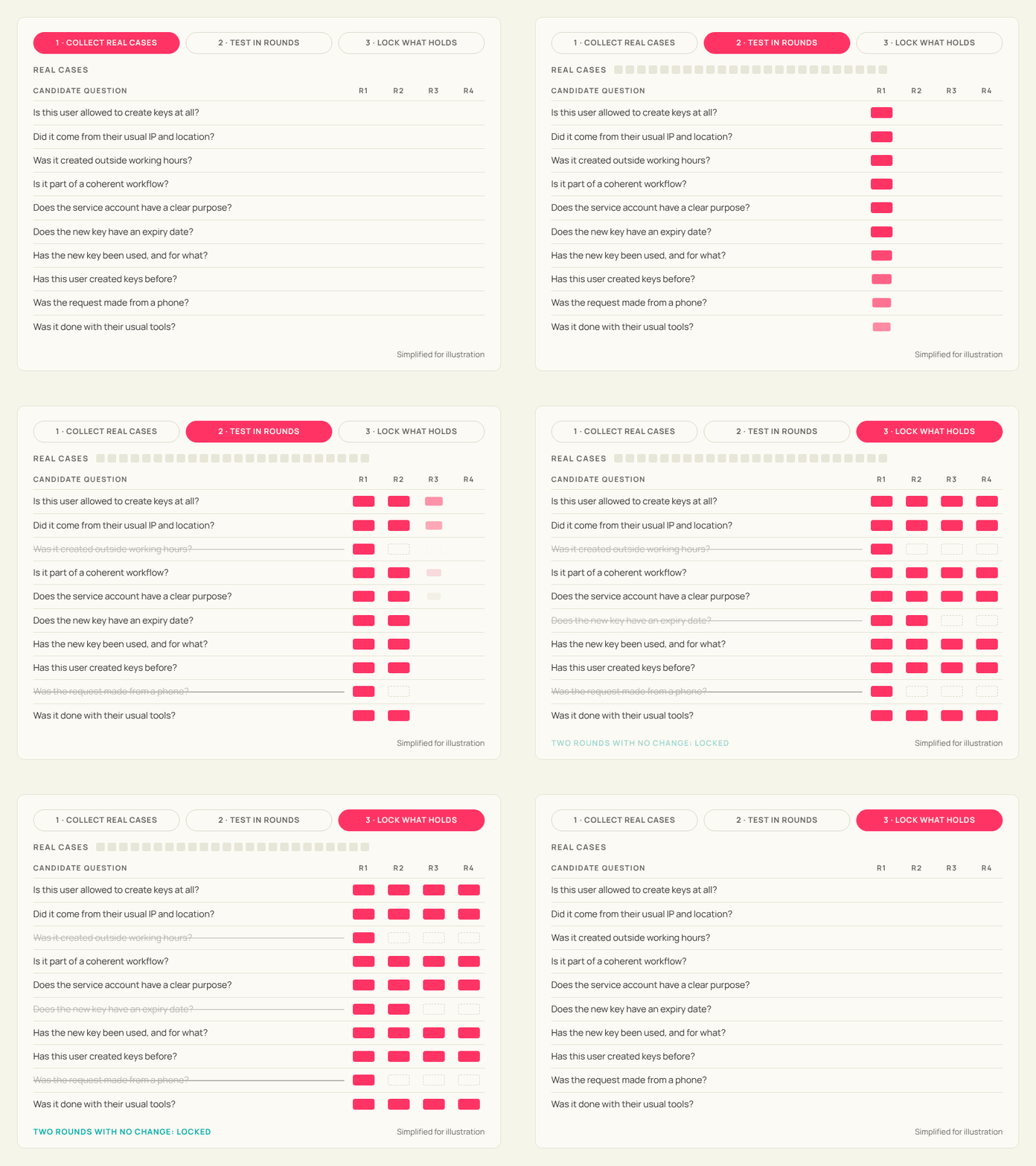
As we integrate new kinds of alerts into Daylight, we wait for them to generate a minimum viable number of cases across different environments. Then we replay those cases, testing candidate questions over several rounds, each a fresh, independent investigation of the same cases. A question stays only if it keeps coming up. The questions that show up inconsistently are removed. When new rounds stop producing new questions, our proven questions are locked in, and they guide how we investigate every case generated by that type of alert.
Here’s what this looks like for one common cloud alert
Someone (or something) creates a new key for a Google Cloud service account, a key that grants standing access to an organization’s cloud infrastructure. This action triggers a key creation alert. Engineers create keys like this every day for a wide array of perfectly good reasons. Adversaries also create them after stealing credentials for a wide array of malicious reasons, ranging from lateral movement to privilege escalation to persistence. When we replayed the cloud key creation alerts, seven questions emerged from the rounds. Two more rounds of real cases didn’t change any of the questions.
These are the seven that held, and what each one is there to settle:
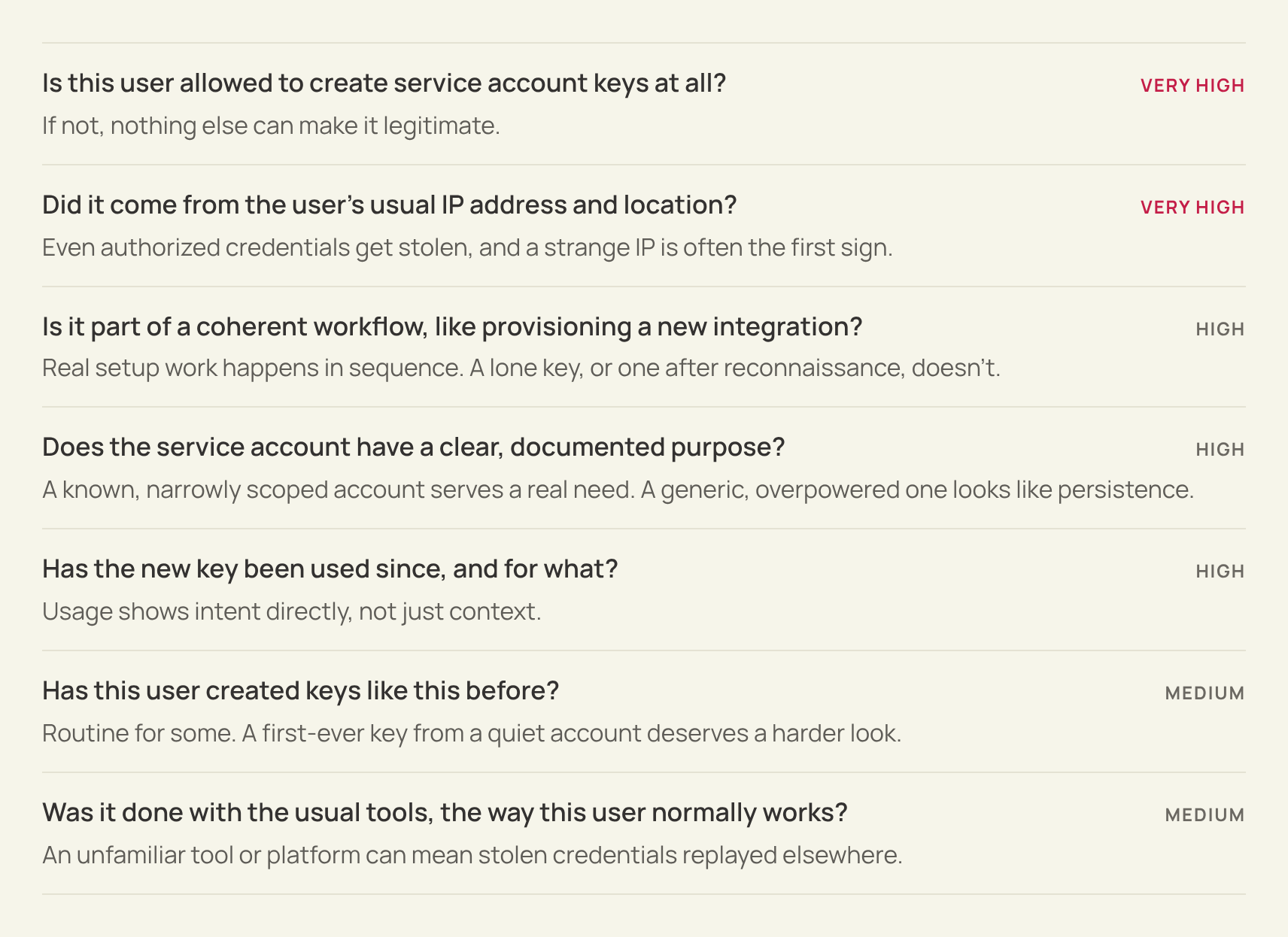
We’ll follow this case through the rest of the post, from these questions to the verdict.
How the investigation reasons
Proven questions establish the repeatable process for conducting an investigation, but our AI agents reason over the answers to those questions in real time, like a senior analyst would. Agents ask every proven question of the systems that hold the answer, often several at once. This often happens across several disparate systems in parallel. This process generates evidence that can then contribute not only to the case we’re investigating but also to other relevant cases.
The knowledge we’ve accumulated about each customer’s environment shapes how the evidence is interpreted, such as knowing which users or teams normally create service account keys. Before we arrive at a conclusion, our agents reexamine the answers to their proven questions, revising them as needed.
Every case gets the same questions, and an answer that’s entirely its own.
Living verdicts
We assign every case a labelled verdict, such as malicious, suspicious, or benign, at the end of an investigation. A living verdict rests on the evidence gathered by answering the proven questions. The living verdict is forever bound to the evidence collected and analyzed in the case, changing only if new evidence is added or existing evidence is removed.
Every answer becomes a finding, and every finding shows its work: how it affected the verdict (decisive, supporting, or just context), whether it indicated malice, how confident we are that it’s true, and what would reverse it. That last part turns a conclusion into an argument you can test. In the service account case, the finding on the user’s role might read: decisive, points to benign, high confidence, but it would change to suspicious if we later learned that the user who created the key works in a non-engineering role or otherwise has no reason to create such keys.
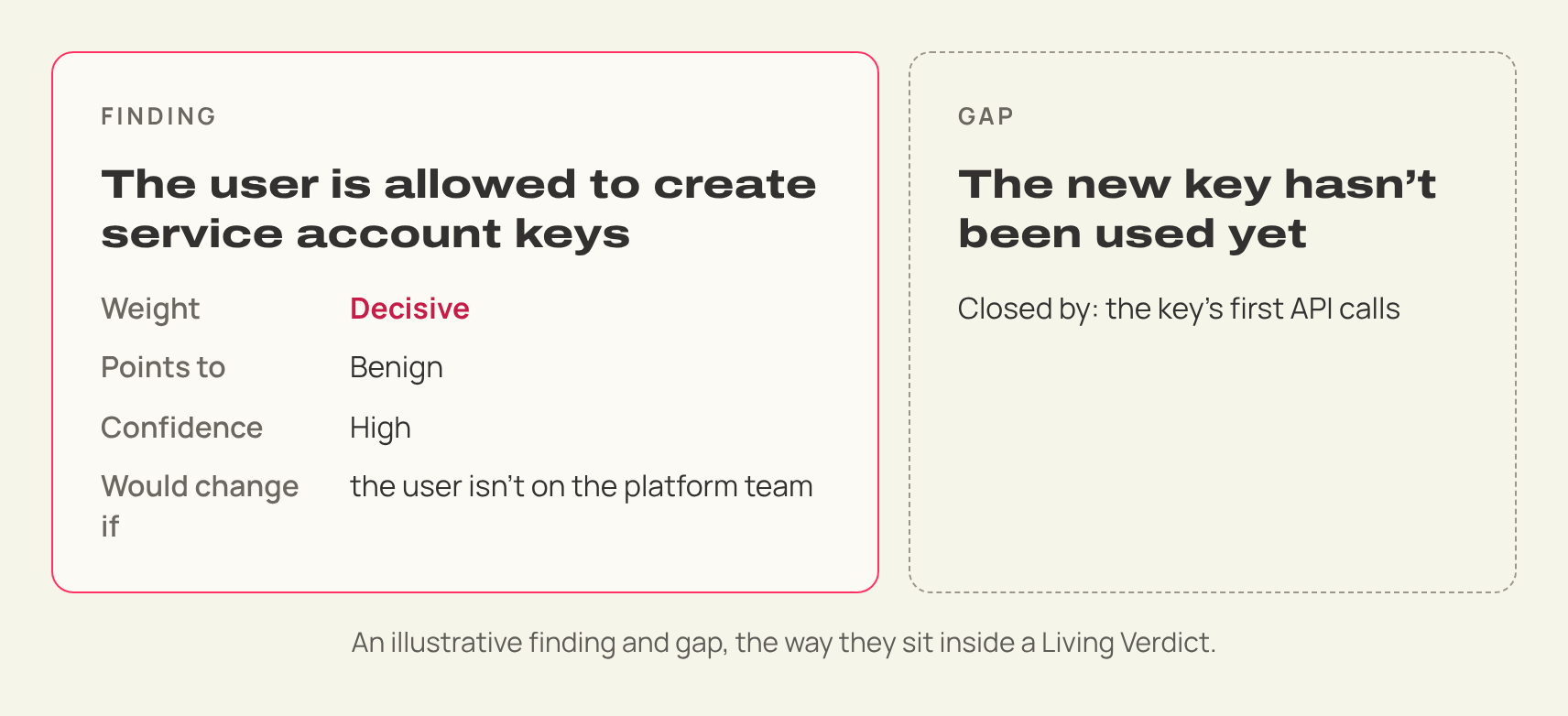
Next to the findings sit the gaps. Every investigation has things it couldn’t see: a log that wasn’t available, a record nobody keeps, a question only a person can answer. Most AI investigation tools leave those out. Every verdict accounts for these unanswered questions, with what each one leaves open and who can close it. In the same case, the new key may not have been used yet, so there’s nothing to show what it’s for. That’s a gap, and the verdict says so: intent is still open, and the key’s first API calls will settle it. A gap isn’t a weakness in the verdict. It’s the next step, already spelled out.
And the verdict doesn’t freeze when the investigation ends. When new evidence or new knowledge lands on a case, we don’t run everything again and hope it comes out the same. We revise only the findings that are affected by the new evidence, the verdict moves with them, and the reason the verdict changed or didn’t is included in the case.
Say that service account key is used an hour later to read storage buckets from a hosting provider’s IP address, rather than a known and trusted IP address. The finding on how the key was used becomes decisive, changing the verdict from benign to suspicious. The gap closes, and the verdict changes with it. Nothing else in the investigation has to be redone, because nothing else changed.
A verdict you can check
The question every security team asks about AI investigations is some version of “can I trust it?” We think that’s the wrong bar. Trust is what you need when you can’t see the work.
Proven questions mean every alert of a given type gets the same scrutiny. Living verdicts let you see how a verdict was reached and what would change it, and you can watch it change when the facts do. Nothing about it asks you to take our word for it.
A verdict you don’t have to trust. One that proves itself.
Subscribe to newsletter
Subscribe to receive the latest blog posts to your inbox every week.




Related posts





For expert judgment, scaled to your world, head for Daylight
