Threat Intelligence Platform: Do You Need a TIP?

.avif)
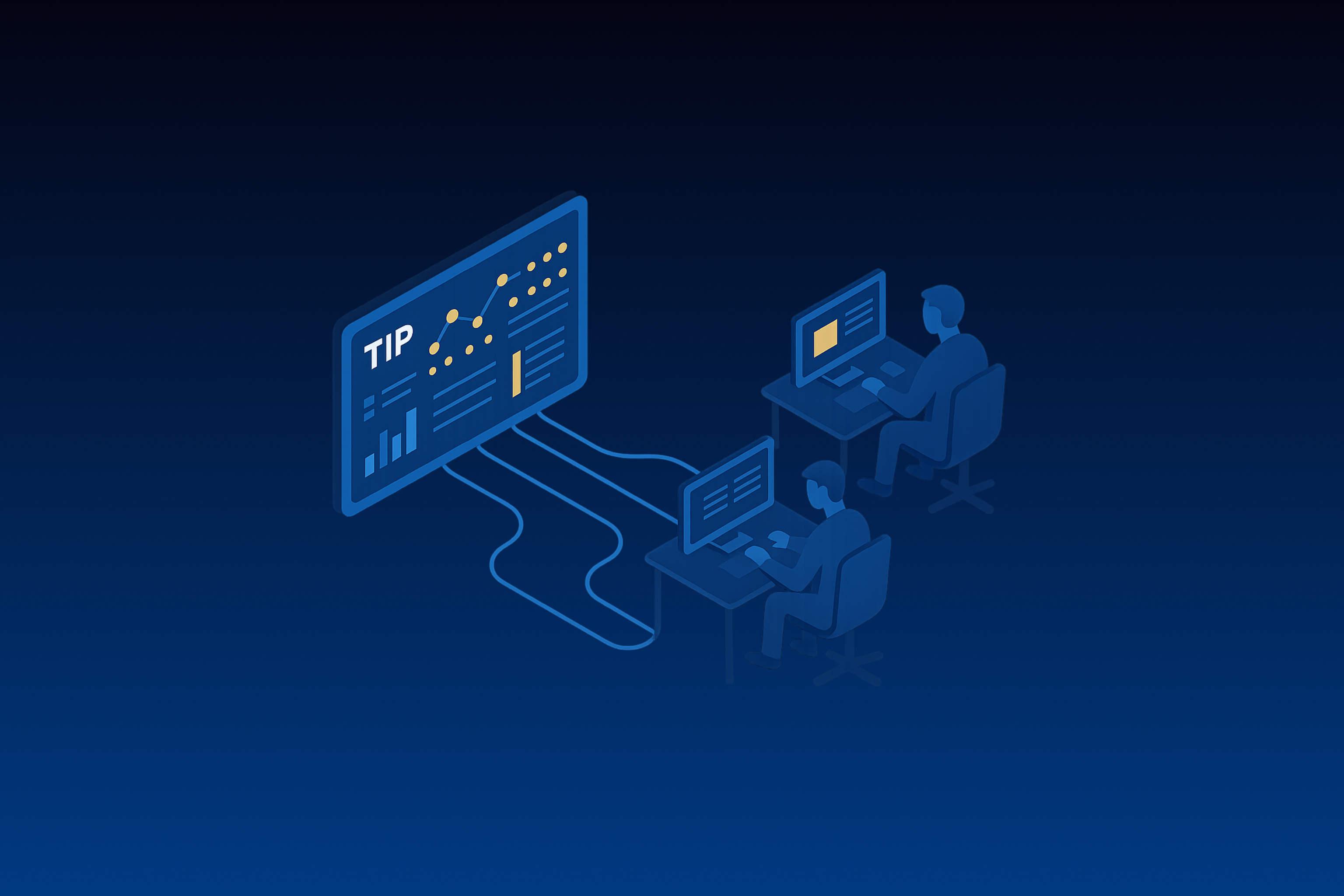
A threat intelligence platform (TIP) is software that collects and contextualizes threat data from multiple sources, then distributes it to security tools and teams. The pitch is coherent on its own terms: aggregate the feeds, normalize the indicators, score them against your environment, push them into detection. What the pitch leaves out is that a platform produces an input rather than an outcome. Someone still has to turn that output into detections and investigated cases.
What decides whether the line item pays off is whether you produce intelligence or only consume it. Organizations that produce intelligence for other recipients need the machinery to structure and distribute it. Organizations that only consume external intelligence usually need the consumption work done, and the platform is the least difficult part of that. The measured research on feed overlap, indicator decay, and how practitioners actually use paid intelligence all points the same way, which is that the data is weaker and the labor heavier than the pitch implies.
TL;DR:
- A TIP is producer-grade infrastructure. It aggregates, normalizes, deduplicates, enriches, scores, and disseminates external threat data, and running it well tends to require dedicated intelligence and detection-engineering capacity that most teams do not have.
- Feed quality is a structural problem that platform tooling alone does not fix. Providers tracking the same actors publish largely different indicator sets, shared indicators arrive late, and buying a larger feed does not reliably buy a cleaner one.
- Managed services invert the model. The provider does the operationalizing and hands back investigated cases, with the engagement scope setting the boundary.
- A standalone TIP remains the right call for intelligence producers and for structured exchange obligations. Machine-to-machine sharing with a community, and regulatory exchange in machine-readable form, justify the platform on their own. Consuming feeds usually does not.
The producer-versus-consumer split is the useful test, and it is the one most evaluations skip.
Inside the Threat Intelligence Platform Pipeline
A threat intelligence platform centralizes the collection, analysis, and distribution of cyber threat intelligence (CTI). Standards work in the field frames that material broadly. NIST SP 800-150 treats cyber threat information as anything that helps an organization identify, assess, monitor, and respond to threats. That covers indicators of compromise, adversary tactics and techniques, suggested detection and containment actions, and findings from incident analysis. A TIP is the machinery that moves such material from an external source into an internal control, and six stages describe most implementations.
- Teams aggregate feeds from commercial providers, open sources, government programs, dark web monitoring, and internal research.
- They normalize the data into consistent formats, commonly STIX with TAXII as the transport, in line with NIST guidance on standardized formats and transport protocols.
- They deduplicate indicators across sources and manage each indicator's lifecycle.
- They enrich indicators with geolocation, reputation scores, malware family associations, and threat-actor context.
- They correlate and score the result against asset criticality and organizational relevance.
- They disseminate what survives into detection and response controls.
Platforms most often stall at this last stage, which makes it the one to check before you buy. A TIP sits alongside the rest of the SOC tool categories as the layer that carries adversary context into detection, which means its value is largely a function of what happens downstream. When the intelligence never reaches a control, dissemination reverts to email and documents, and the platform becomes a well-organized archive.
The evaluation gap runs deeper than integrations. ENISA's 2018 study of the category recommended that platforms improve their threat triage and relevancy assessment capabilities and offer more usable trust modeling. The products have moved on since, but the critique still names where the hard problems sit. Aggregation and normalization are largely solved. Deciding which indicators matter for a specific environment, and how much to trust each source, is the part that still needs a person.
Why Feed Quality Limits What a TIP Can Deliver
The data a TIP processes has a measured quality problem that platform tooling does not correct. The first empirical assessment of commercial threat intelligence services compared two leading paid vendors and found almost no overlap between them, or with four large open feeds. Restricted to 22 threat actors both vendors explicitly claimed to track, average overlap ran between 2.5% and 4.0%, and the indicators that did appear in both arrived in the second feed with an average delay of a month. The same work interviewed practitioners who buy paid intelligence. It found they built their workflows around their scarcest resource, analyst time, and judged intelligence by informal heuristics with little quantitative measurement behind them. A TU Delft study presented at ACNS 2020 analyzed 1.38 million indicators across 24 open-source feeds and found that only 6.2% appeared on more than one feed, and that most indicators were already active for at least 20 days before any feed listed them. Late and non-overlapping are a bad combination for a control you are paying to keep current.
Those findings describe the coverage and timeliness limits of indicator feeds specifically. They do not imply that contextual analysis, original research, or finished intelligence produced with platform support carries the same limitations. Adversary research and indicator data are different products, and threat intelligence services sell them at very different depths. Conflating the two is how CTI budgets end up funding one while the team expects the other.
Indicators also age. Research on indicator shelf life treats a finite time-to-live before eviction as the sensible default, which means much of a feed's content is stale by the time a lean team gets to it. That is one reason mature programs turn validated hits into standing detection rules instead of running repeated IOC sweeps against the same indicator lists.
Volume does not fix any of this. In a comparative study of 47 IP feeds and 8 file-hash feeds, false-positive rates were not strongly correlated with feed volume, so a bigger subscription is not reliably a cleaner one.
A definitional point sits underneath the measurements. Treating indicators as finished intelligence confuses a process output with intelligence itself. Intelligence answers a question someone asked, and aggregating indicators does not produce that answer on its own.
What Running a TIP Costs Beyond the License
Most intelligence functions run lean. The 2026 SANS CTI survey, which drew 401 responses, reports that most formal CTI teams stay under four full-time employees. It also finds that a lack of time to implement new processes and a lack of funding are the two most-cited barriers to effective CTI, each named by 44% of respondents. The survey is sponsored in part by threat intelligence vendors, including platform vendors themselves, which is worth noting when the findings bear on whether to buy a platform. Neither finding is surprising for functions of that size.
Those two constraints compound. A platform adds process, and process is what a time-constrained team has the least room to absorb. The license is rarely the binding cost. The binding costs are the people who curate sources, tune scoring against the asset inventory, and maintain the integrations that carry output into controls, plus the detection-engineering capacity to convert what arrives into rules worth keeping. Using multiple commercial sources also means licensing multiple feeds, and senior intelligence and detection talent is expensive and hard to hire in most markets.
None of that means the platform is badly built. It means the platform assumes an operating model. A TIP is most defensible as production and exchange infrastructure, where the machinery is the deliverable. Teams that only consume external intelligence are buying infrastructure for a job whose expensive part sits somewhere else.
Buying the Outcome Instead of Running the Platform
The alternative is to change who does the work, and three models answer that differently. Traditional MDR is a managed service: the provider investigates alerts with practitioner-led workflows and takes response actions within an agreed scope, applying intelligence inside its own detection rules and investigations. AI-native MDR is also a managed service, delivering that same accountability on architecture built for AI from the start, though capabilities vary considerably between providers. AI SOC platforms sit on the other side of that line, because they are software the customer runs: they automate triage and investigation while the team keeps ownership of response and outcomes.
Handing the work to a provider changes where the intelligence lands. Threat intelligence informs its rules and enriches the investigations those rules and your existing tool alerts trigger. Instead of a scored indicator list, you get a case with a verdict attached. Whether that is an improvement depends on the quality of the investigation behind the verdict, which is the thing worth testing during an evaluation.
Two questions separate real intelligence delivery from a monthly report. Ask how an observed threat at one customer becomes a detection at yours, and how quickly. Then ask whether the provider can use data across endpoints, cloud, identity, and SaaS to investigate an alert end to end and reach a clear verdict without handing the investigation back to your team. A provider that can show that path, with an auditable trail, is delivering intelligence operationally. One that answers with a feed count is not.
Because a platform and a service are not strict substitutes, the comparison below sets the two operating models side by side.
These are tendencies, and exceptions run both ways. A well-staffed intelligence program can make a TIP earn its cost several times over, and a weak managed engagement can leave the consumption work undone while appearing to cover it.
Deciding Between a TIP, a Managed Service, or Both
The producer-consumer split decides most of this. Team size on its own does not, and a small team with genuine production obligations still needs the platform.
- If you produce original threat intelligence for a sharing community, for regulators, or for other external recipients, a TIP is justified infrastructure. Production requires machinery to aggregate, structure, and distribute what you publish.
- If your community participation requires machine-to-machine sharing, you need STIX/TAXII capability on your side of the exchange. FS-ISAC's operating rules treat STIX/TAXII and MISP accounts as machine-to-machine consumption and decommission automated feed accounts left unused for 90 days or more, and CISA's AIS program requires a TAXII 2.1 client.
- If you are a financial entity under DORA and choose, or are contractually required, to exchange intelligence in machine-readable form, structured exchange tooling may belong in scope. The regulation explicitly permits entities to exchange intelligence, including indicators and adversary tactics, within trusted communities.
- If you have dedicated intelligence staffing plus detection-engineering capacity to consume platform output continuously, evaluate whether the platform pays off in your operating model. Few teams are in this position.
- If your intelligence function is a fraction of one to four people consuming external feeds, consider buying the outcome instead. Evaluate whether a provider can cover the consumption workflow the platform was meant to support, with less operating burden, by turning intelligence into investigation triggers and investigated verdicts. The agreed scope sets that coverage, so read it closely.
- If dissemination today is email and documents, start with a workflow the team can run consistently. Add tooling once data volume forces the change.
The first three conditions describe producers. The last three describe a substantial share of the market. Both can be true at once, and a team with real publishing or exchange obligations plus a thin consumption workflow is the clearest case for running a platform and buying the consumption work alongside it. If none of the producer conditions apply, the platform may be funding infrastructure for a job that sits outside it.
Where the TIP Line Item Earns Its Budget
A threat intelligence platform is valuable for intelligence production and structured exchange, and that case does not depend on how large the team is. For teams that primarily consume external intelligence, the better question is who turns that intelligence into investigated verdicts and agreed response actions, because that is where the cost and the risk actually sit.
What external feeds rarely supply, whichever model you pick, is what normal looks like inside your specific organization. Identical alert signals deserve different risk assessments depending on the policies, exceptions, and history around them, and that judgment has to live wherever the investigations run. Daylight is a MASS company, meaning it offers managed agentic security services for Security Operations. Its portfolio spans AI-native MDR, threat hunting, and the Agentic Security Data Lake, and its intelligence work shows up inside the investigations it runs, so your team has no separate feed to route.
Frequently Asked Questions About Threat Intelligence Platforms
Do MISP or OpenCTI Avoid the TIP Cost Problem?
They remove licensing fees, not operating costs. Both require teams to provision and maintain the supporting infrastructure, including OpenCTI's dependencies on Elasticsearch, Redis, RabbitMQ, and object storage, and the documented MISP requirements for compute, memory, database, and storage. Since the platform was rarely the expensive part, removing its price tag rarely changes the decision. Compare self-hosted and managed options on total operating effort.
Is the Standalone TIP Market Consolidating?
The recent pattern says yes. Mastercard acquired Recorded Future in a $2.65 billion deal in 2024, and Dataminr acquired ThreatConnect for $290 million in 2025, with other standalone vendors absorbed in the same stretch. Buyers should plan for a standalone product to become part of someone else's broader platform, and should ask what happens to their integrations and contract terms when it does.
Does a Managed Service Replace a TIP for ISAC Participation?
Not for the sharing side. A managed engagement can cover your detection and investigation consumption, but sharing obligations usually require a STIX/TAXII-capable system on your side of the exchange if membership involves automated feeds, whether that is a TIP, MISP, or a managed equivalent. The two purchases solve different problems and often coexist without redundancy.
Should We Keep a TIP We Already Own?
Keep it if it does producer work, meaning original intelligence you publish or structured exchange obligations you have to meet. Consider sunsetting it if its only job was pushing scored indicators into your SIEM for your team to chase. A capable managed engagement may absorb that consumption work within its agreed scope, and paying for both can mean paying twice for the same side of the problem.
How Do You Separate Real Intelligence Delivery From Marketing?
Ask for evidence of the mechanism, in writing, before signing. Feed counts show what a provider buys and say little about what it does with the intelligence. The useful tests are whether the engagement reduces your team's alert workload or adds a queue, and whether you can see how each verdict was reached, including which intelligence and which context informed it. Anything you cannot inspect after the fact should be treated as a marketing claim until the provider shows the record.