AI Threat Hunting: How Agentic AI Is Changing the Hunt

.avif)
You know the honest answer to "how often does your team actually hunt?" It's not as often as the risk deserves. Between clearing the alert queue and covering shift rotations, the hypothesis-driven work that finds what your detections miss keeps sliding to the bottom of the list. Meanwhile attacker timelines keep compressing: Mandiant's M-Trends 2026 report found that the median time between initial access and hand-off to a secondary threat group collapsed from more than eight hours in 2022 to just 22 seconds in 2025. The window between a hunt cadence measured in months and an attacker operating in seconds is a gap you cannot staff your way out of.
That mismatch is why AI and agentic automation are now a real operational question. Automation and agentic AI raise a practical decision: which parts of the hunt scale, and which parts break when you hand them to a model. Divide that labor carefully.
TL;DR:
- Agentic AI changes the trigger and the speed. Traditional hunting often starts from alerts or external intelligence and therefore gravitates toward known threats. Agentic systems can continuously test assumptions even when no alert fires, which gives teams a structural answer to identity-led attacker behavior that avoids malware and uses SaaS access.
- Hypothesis generation stays human; search and correlation scale with AI. Security practitioners understand business context and which risks are worth chasing. AI compresses the hours of cross-tool data gathering into minutes. The division of labor is what makes hypothesis-driven hunting scalable.
- Context engineering tends to carry more weight than model choice. That explains why reported SOC value can lag AI deployment: deployment breadth is not effectiveness.
- Autonomy without governance creates new failure modes at machine speed. Hallucinated queries and prompt injection through log data are documented risks. Teams getting value keep humans on the verdict for novel TTPs and customer-facing action.
What "Agentic" Actually Changes in the Hunt
Agentic AI replaces rule-triggered hunting with goal-oriented investigation. Traditional AI in the SOC has usually helped with repetitive tasks inside predefined logic. If a condition matched, the system executed the next step. By contrast, agentic AI systems plan and execute multistep workflows with memory and adaptive planning. For hunting, that difference changes the operating model.
When threat hunting begins from alerts, incidents, or external intelligence, the work naturally leans toward what is already known. Agentic systems shift the operating model toward continuous hypothesis testing around attacker objectives, such as credential abuse or lateral movement, even when no alert is present. That matters when adversaries operate through valid credentials and trusted identity flows, including approved SaaS integrations. Hunting that waits for an indicator to fire is structurally weak against that kind of intrusion.
Autonomous Investigation Loops
SOAR is built around predefined branches: a condition is met, and the workflow runs the steps attached to that condition. Agentic investigation is less rigid. It uses the evidence collected so far to decide what to inspect next.
The agent checks whether the current evidence is sufficient. If it is not, it revises the path, pivots on what it just learned, and narrows or expands the investigation. That resembles a human hunter working through uncertainty. The hunter follows the useful clue and drops the dead end, then goes deeper only when the data justifies it.
Domain-Specific Agent Specialization
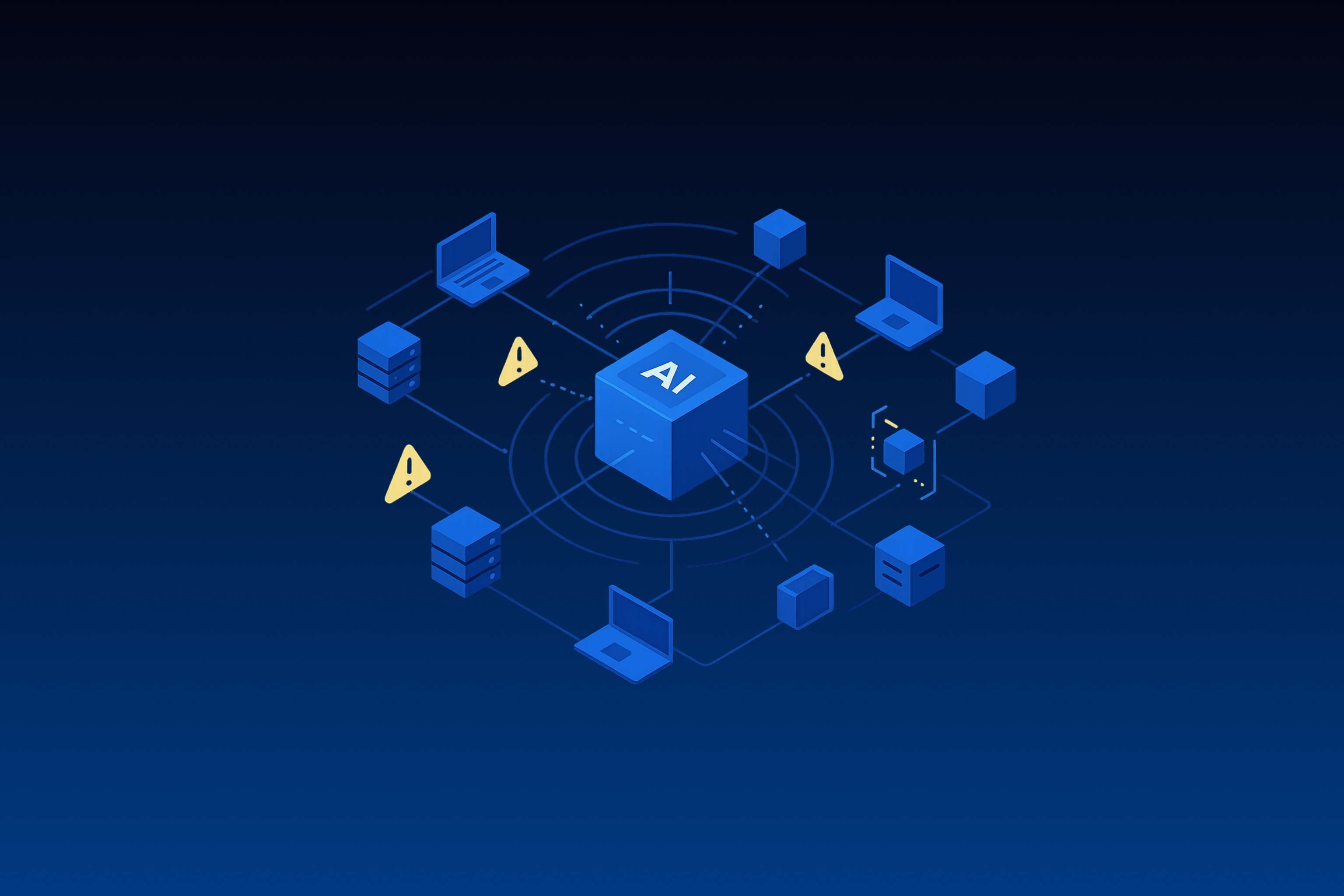
One production pattern mirrors human SOC team structure, but in software. One agent might focus on cloud infrastructure, another on identity behavior, another on endpoint activity, and another on network flows. Specialization keeps the tool choices and reasoning paths specific to the domain being investigated.
Research on production agentic systems describes hierarchical architectures where a high-level manager LLM decomposes the goal and delegates to specialized sub-agents, while deterministic ML detectors run at line rate on raw telemetry and LLM agents reason only on flagged events. The appeal of that pattern is that it limits LLM reasoning to the events that need semantic interpretation. The model reasons about the subset that needs reasoning instead of looking at everything.
Natural Language Hypothesis Initiation
Hunters can start with the question they actually need answered: "Are we impacted by this campaign?" or "Where else is this activity happening?" The system can then translate that question into evidence-gathering work across identity logs, endpoint telemetry, cloud activity, email, and SaaS records. Cross-tool collection and correlation move faster than a human working each console by hand.
Teams ingest new threat context, turn it into huntable hypotheses, craft detection queries, refine those queries to reduce false positives, and run them across stored metadata. When agentic hunting works, the tedious part is compressed, the query is validated, and the hunter's time goes to judgment.
Where the Automation Actually Breaks
Understanding documented, specific failure modes separates a working deployment from one that underperforms. Teams still need supervision for LLM query generation. The approach can work with schema grounding, but does not transfer cleanly to SIEM query languages because those languages need security-specific temporal operators and event correlation logic that standard SQL does not provide. An empirical evaluation on Microsoft Defender for Endpoint found pass-the-hash rules required manual correction due to schema inconsistencies and invalid field references, while other rule types performed better. Query generation quality varies by TTP, so validation still matters.
Hallucination Is Structural
LLMs fill gaps in training data using statistical patterns without truly understanding content, so they produce answers that sound correct but are unfounded. In a SOC, those hallucinations create false positives that erode practitioner trust and increase overhead. Over time, teams may normalize high volumes of irrelevant alerts.
A model that lacks grounding to your specific environment can produce an operationally wrong assessment even when it does not hallucinate. The grounding survey makes the point precisely: a well-supported, non-hallucinated claim that disagrees with the provided knowledge base is still considered ungrounded. A model can be factually correct about attacker technique and still wrong about whether the activity is malicious in your environment.
A practical risk also surfaces in hypothesis development: a model can reinforce a weak theory if the hunter frames the question as a request for validation. Mitigate that risk by asking questions constrained by observable facts rather than prompts that invite the model to validate a theory.
Agentic Autonomy Introduces New Attack Surface
Handing a system broad access and persistent memory changes the risk profile. The more authority an agent has, the more important it becomes to constrain what it can read, write, remember, and execute. A USENIX Security 2026 paper demonstrated that adversaries can inject malicious log content that LLM agents consume. Your hunting agent reads telemetry; telemetry can be poisoned.
Agents can drift operationally: an agent can take several flawed steps before anyone sees the pattern, unlike a software crash that fails loudly. SANS warns that ungoverned autonomy invites unauthorized actions, data exfiltration, misconfiguration, and stealthy evasion. Start AI-assisted, introduce autonomy with human-in-the-loop control, then expand scope deliberately.
The Human-AI Division of Labor
Evaluate each hunt step separately instead of using platform autonomy as the primary measure. Some steps become repeatable automation, some get AI augmentation, and some stay human-owned. A practical operating model looks like this:
Hypothesis generation remains a human responsibility. Deciding which risk is actually worth testing relies primarily on threat context and business judgment: what the organization looks like, which assets matter most, and how adversaries are likely to target this specific environment. AI can surface candidate hypotheses from advisories and flag patterns worth a second look, but security practitioners own the call, with AI serving as a sounding board rather than the source of the final hypothesis.
AI tools can absorb much of the repetitive SOC work that consumes security practitioner time, including alert review, enrichment, cross-source correlation, and evidence assembly. Strategic work such as detection engineering, hypothesis-driven hunting, incident command decisions, and organizational context still relies primarily on human judgment and direct engagement with how the business actually operates. The role now centers on interpreting and refining AI findings, and detection engineering and threat hunting are becoming the most valuable SOC skills.
Improved detection accuracy does not, by itself, make autonomous decisions safe; human oversight remains necessary for high-impact decisions. Automation creates speed, and keeping a human able to say no improves accuracy on the cases that matter.
What Continuous Automation Changes About Cadence
Automation turns episodic hunting into a continuous function. Threat hunting should run continuously to match the 24/7 cadence of automated detection, but many programs still depend on scarce expertise and hands-on-keyboard investigation for every hypothesis.
MITRE's TTP-based hunting guidance notes that data collection starting post-compromise is less effective than continuous, ongoing monitoring because of the difficulty of covering the time domain. Agentic systems can provide persistent visibility without relying on a human operator to manually execute every query, so operators are less likely to miss emerging threats during off-hours or shift changes.
Two caveats keep this honest. First, hunting should be treated as a human-directed process: SANS is direct that it remains a human-powered process to generate hypotheses and apply techniques. Second, behavior is the durable target for continuous hunting. MITRE recommends TTP-driven hunting because TTPs are more difficult for adversaries to change than IoCs and many TTPs are observable across multiple campaigns.
Continuous hunting also creates a feedback loop into detection. Hunting validates detections, identifies gaps, and feeds outputs back into the detection library over time. Automation makes that loop run continuously instead of once a quarter.
Decision Criteria for Evaluating AI Hunting Approaches
Choose based on your stack and maturity. These criteria are conditional.
- If your stack is fragmented across multiple vendors, then prioritize a tool that can investigate consistently across all of them over any single platform's autonomy depth. A tool that works only inside one platform may be powerful inside that boundary and weak everywhere else. A vendor-agnostic service layer can reduce dependence on any one upstream platform and preserve investigation coverage across the stack you actually run.
- If you are drowning in false positives, then interrogate the data grounding before the model. Treat the context-value claim as directional: a tool bolted onto ungrounded data will underperform regardless of the model behind it. Ask how the system builds context about your environment before comparing LLMs.
- If you operate in a regulated industry, then require transparent AI reasoning. That comes down to the difference between trusted and trust-me systems. Black box systems that cannot show every step, exportable and audit-ready, become practical compliance blockers.
- If you are granting agents any action authority, then demand least-privilege scoping and a human veto on novel verdicts. Agentic systems should receive only the permissions required for the task and only for the duration of that task. Ambiguous cases should route to a human rather than auto-close. Microsoft's AI Red Team taxonomy of agentic-system failure modes documents agent compromise, memory poisoning, and multi-agent jailbreaks as named categories.
- If your hunt program is still ad hoc, then fix data coverage before buying an agentic tool. Start by confirming whether you have usable coverage across identity, endpoint, cloud, SaaS, network, and email. Cloud and SaaS gaps create specific blind spots because the important evidence often spans identity activity and control-plane changes. Data-plane access adds another source that the hunt may need. An agent cannot hunt in telemetry you are not collecting.
Across these criteria, evaluate AI as an augmentation of human expertise.
Why Expert-Defined Hypotheses Plus Agentic Execution Is the Model That Holds
The durable model pairs expert-defined hypotheses with agentic execution. Security practitioners decide which risks are worth testing, define the hypothesis, and own the judgment. Specialized agents execute the search work, collecting evidence, correlating across domains, querying historical data, and surfacing the findings that deserve human review. That is what makes hypothesis-driven hunting viable as a continuous function rather than a periodic exercise dependent on scarce senior time.
It also separates service scope cleanly. Daylight is a MASS company, meaning it offers managed agentic security services for Security Operations: it starts with AI-native MDR and extends the same context-first, agentic architecture to threat hunting, phishing response, and DLP. Threat hunting is a separate service from daily MDR activity. Within an MDR engagement, targeted threat hunting happens only in response to major known attacks, roughly once every six months, and even then, it is scoped and billed separately rather than folded into daily MDR operations. As a dedicated threat-hunting service, expert-defined hypotheses and IOC sweeps can run through agentic execution across endpoint, identity, cloud, and SaaS logs.
Frequently Asked Questions About AI Threat Hunting
Does AI Threat Hunting Replace the Need for a Dedicated Threat Hunter?
No. Hypothesis generation depends on understanding business context and which risks are worth chasing, so it should stay human-owned. The hunter shifts time away from manual cross-tool data gathering and toward framing hypotheses and judging novel TTPs. Validated findings can then move into production detections.
How Do I Know if a Vendor's "Agentic" Hunting Is Real or Repackaged SOAR?
Ask what happens when the initial hypothesis is wrong. SOAR runs a fixed script: if this condition, then these steps. Genuine agentic investigation evaluates the evidence it has gathered and decides the next step from that, pivoting when findings warrant it. Systems that only execute predefined branches are just faster SOAR.
Why Do So Many AI Hunting Deployments Underperform Despite Good Demos?
Context engineering tends to matter more than model selection. Use the 90/10 framing as directional. Teams that deploy a tool onto ungrounded, incomplete, or noisy data get high false positive rates regardless of the model. The reported SOC-value figure reflects deployment breadth outpacing the data-quality investment that makes AI hunting work.
What Is the Risk of Letting Agents Take Autonomous Actions During a Hunt?
Agentic systems with action authority and persistent memory can take multiple flawed actions before the drift is visible, unlike a software crash that fails loudly. Documented risks include telemetry poisoning through injected log content and privilege abuse. Use least-privilege scoping with task-expiring permissions, a human veto on novel or high-impact verdicts, and immutable audit trails.
Is IOC-Based Hunting Obsolete Now That TTP-Based Hunting Is the Focus?
No, they serve different purposes. IOC-based sweeps are efficient for validating known indicators quickly across your environment, which is what you want when a new campaign breaks and you need to answer "are we affected." Indicators rotate quickly, so IOC hunting alone is reactive. TTP and behavior-based hunting is the durable complement because techniques are harder for adversaries to change. A mature program runs both, with IOC sweeps for speed and hypothesis-based hunts for depth.