Spear Phishing vs. Phishing: Why the Distinction Matters

.avif)
A user reports a suspicious email. It goes into the phishing queue, and whoever is on shift runs the same workflow regardless of what that email actually represents. For a mass-distributed credential harvester impersonating a shipping notification, that works fine.
But for a business email compromise (BEC) attempt where an attacker spent weeks studying your CFO's communication patterns, approval workflows, and vendor relationships before sending a single email? That same workflow misses the attack entirely.
Phishing is broad and volume-based. Attackers send millions of messages using generic templates and commodity lures. Success depends on scale. A campaign targeting 100,000 people yields thousands of compromised credentials with near-zero per-target investment.
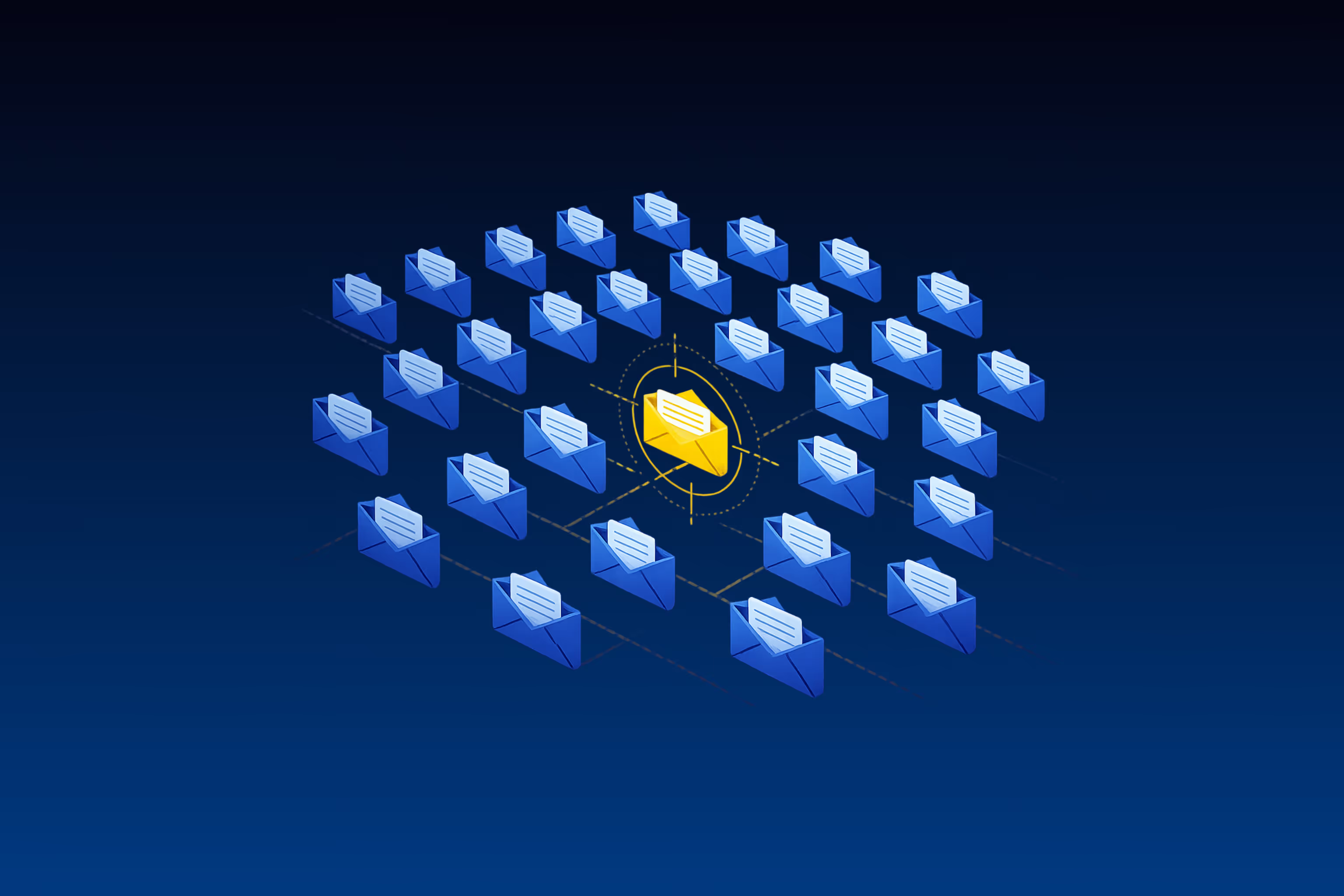
Spear phishing is researched and targeted. Attackers invest weeks of reconnaissance per target through LinkedIn profiling, corporate website analysis, and social media scraping. They build pretexts that reference real projects, real relationships, and real business processes. The goal is wire fraud, access to crown-jewel systems, or long-term persistence inside a specific organization.
The two attack types need different detection rules, different triage priorities, different escalation paths, and different response timelines.
TL;DR:
- Most SOCs run a similar workflow for every phishing alert. That works for mass campaigns but misses targeted BEC attacks.
- Generic phishing leaves detectable signatures and can be automated. Spear phishing often bypasses traditional signature-based controls and requires behavioral detection plus business context.
- Detection, triage, escalation, and response timelines all need to differ between the two. So do MFA policies and security training, tiered by user risk.
- The operational gap comes down to context: knowing whether a request is normal for this user, this vendor, this time.
Spear Phishing vs. Phishing: Major Differences
The two threat types diverge across every dimension that matters to your SOC: who gets targeted, how attacks are built, how they evade detection, and how much damage they cause.
1. Targeting and Reconnaissance
Generic phishing casts the widest net possible. Attackers purchase recipient lists by the million and send the same template to everyone. There's no research, no personalization, and no per-target investment.
Spear phishing starts with homework. Attackers scrape LinkedIn for org charts, analyze corporate websites for project names, study financial filings for transaction patterns, and map vendor relationships through press releases. Targets are handpicked: CFOs, IT administrators, HR personnel with authority over financial transactions or sensitive systems.
Example: a generic phishing campaign sends a fake Microsoft 365 password reset to 50,000 inboxes. A spear phishing attack sends your CFO a single email referencing last quarter's vendor payment schedule, timed to arrive during the month-end close.
2. Attack Tooling and Execution
Generic campaigns launch within hours using reusable phishing kits. These kits automate landing page creation, credential harvesting, and exfiltration. Modern kits embed obfuscated JavaScript that manages the full attack flow, including logic that responds to credential attempts with "Incorrect password" prompts to capture real passwords.
Lure categories are predictable:
- Fake invoices
- Password reset requests
- Shipping notifications
- Account security warnings
Spear phishing is multi-stage. Attackers establish legitimacy with a low-risk interaction, build trust through follow-ups across channels, then deliver the high-value request. They exploit specific business processes:
- CEO fraud
- Vendor invoice manipulation
- Attorney impersonation
- Targeted data theft
Attackers often maintain access for months before executing their primary objective, persisting through email rules, OAuth tokens, or additional account compromises.
3. Detection Difficulty
This is where the distinction matters most for your team.
Generic phishing leaves identifiable signatures. This includes known malicious URLs, template patterns, volume anomalies, and sender reputation failures. Your secure email gateway and URL reputation tools can catch the majority.
Spear phishing bypasses all of that. Messages often originate from compromised legitimate or carefully spoofed domains. They contain no known malicious indicators and arrive in volumes too low to trigger anomaly detection. The attacker invested weeks building a convincing pretext, which is why these emails look legitimate to every automated control in your stack.
4. Financial Impact and Damage
Generic phishing operates on volume economics. Individual incidents may start with a compromised credential or a stolen session token, but can escalate depending on the account’s access
On the other hand, BEC and spear phishing can cause catastrophic per-incident losses. A single successful BEC targeting accounts payable can result in six- or seven-figure wire transfers.
Beyond direct financial loss, attackers who gain persistent access can exfiltrate sensitive data, move laterally across systems, and maintain a presence long enough to execute multiple objectives.
How Spear Phishing Changes Your Security Operations
When your SOC applies the same workflow to both threat types, one of two things happens. Either generic phishing consumes disproportionate analyst time because every email gets the same investigation depth, or spear phishing gets processed with the same automated triage as bulk campaigns, and the targeted attack slips through.
And the cycle feeds itself. Volume overwhelms the team. Analysts don't have time to audit and tune detection rules. Noisy rules persist. Volume grows.
Detection Rules Need Architectural Separation
Generic phishing detection relies on known indicators: malicious URL databases, sender reputation scoring, and attachment hash matching.
Spear phishing detection requires a different approach entirely:
- Behavioral analytics that flag unusual sender patterns from legitimate accounts
- Communication anomaly detection relative to established baselines for each user and vendor relationship
- Business context awareness that catches finance-related language from unfamiliar but plausible-looking domains
- Coverage for zero-day exploits and dynamic URLs that bypass traditional filtering
Triage and Escalation Criteria
Generic phishing alerts can be batched, clustered by campaign indicators, and processed in bulk. Spear phishing targeting C-suite or finance roles warrants immediate human analysis.
Critical escalation indicators for targeted attacks:
- Requests involving funds transfers or bank account changes
- Reply-to addresses that don't match the displayed sender
- Requests to bypass established approval processes
- Unusual timing or channel for the type of request being made
Escalation logic differs, too. Generic phishing follows standard severity levels with automated processing. BEC incidents require dynamic risk-based escalation with lower thresholds, adapting as the investigation progresses.
Response Timelines
For generic phishing, the response can follow standard SLAs. Batch the alerts, remediate during normal workflow cycles, and reset credentials for affected users. Delays can increase risk because attackers may use stolen credentials quickly after compromise.
Spear phishing and BEC are different. Attackers move laterally, usually within hours of initial compromise. They establish persistence through email forwarding rules, OAuth app grants, and secondary account compromises. Every hour of delay gives them more footholds.
BEC targeting finance or executive roles demands immediate containment. That means your team needs to identify, investigate, and begin response actions as soon as the alert surfaces, not after it sits in a queue waiting for a shift change.
If your current workflow can't reliably hit that timeline for targeted attacks, the next section breaks down what the two response models should actually look like.
Detection and Response for Phishing: Two Different Workflows
Here's what separate workflows for generic and spear phishing look like in practice.
High-Volume Generic Phishing Response
For mass phishing, the goal is to eliminate analyst involvement for the predictable majority. Stack your automated detection layers:
- Email authentication validation (SPF, DKIM, DMARC).
- Attachment sandboxing and URL reputation checking.
- Threat intelligence correlation to identify known campaign infrastructure.
When automated systems detect campaign indicators, cluster similar emails and execute bulk remediation: quarantine all instances, block sender domains, trigger credential resets for anyone who interacted. High-confidence detections should go straight to quarantine without human involvement. Medium-confidence alerts go to analyst review with pre-populated context.
Don't overlook trained user reporting. Organizations that invest in adaptive phishing training see meaningful improvements in reporting rates within a year.
Your people become detection sensors that catch what automated controls miss, both confirming mass campaigns your tools already flagged and surfacing subtle BEC attempts that bypassed technical controls entirely.
Spear Phishing and BEC Investigation
Targeted attacks need a fundamentally different investigation process. Detection starts with behavioral indicators that pattern-matching misses:
- Emails referencing non-public information like internal project names or unreleased financial details.
- Requests that deviate from established business processes, such as changing payment accounts or bypassing approval chains.
- Display name spoofing paired with mismatched reply-to addresses.
- Impossible travel scenarios or concurrent sessions from different locations in authentication logs.
When investigating, retrieve original messages rather than forwarded copies (which strip complete headers). Analyze authentication results headers and cross-reference sign-in logs for geographic anomalies.
For any finance-related request, verify through a different channel. Call a known number. Never reply to the email. Work directly with finance and executive teams to implement payment holds and notify banking partners.
Post-compromise, assume the attacker has been present longer than the detected activity suggests. Some BEC attackers maintain access for extended periods before executing their objective, so retain email infrastructure audit logs for at least six months to support forensic investigation.
Why Phishing Detection Is Becoming an Investigation Problem
Most organizations have the tools for basic phishing defense. Secure email gateways, URL filtering, and attachment sandboxing. These controls reduce the volume of malicious emails but do not eliminate the investigation workload.
In addition, a significant portion of phishing investigations originates from user-reported emails rather than automated detections. These reports often arrive with limited context and inconsistent descriptions, making the investigation slower and more manual. Organizations also tend to investigate every report to encourage employees to keep reporting suspicious emails.
The gap remains in the investigation. When a targeted email bypasses automated controls, the real question is whether your team can determine what it represents before the attacker achieves their objective.
That requires context: knowing whether a request matches how this vendor normally communicates with this person, from this location, at this time. That context spans telemetry from integrated tools, organizational knowledge specific to the customer environment, and historical patterns from past investigations, not just the email content itself.
This is the gap legacy MDR workflows weren't built to close. Daylight's architecture connects signals across identity, email, endpoints, and business systems and uses that context to run agentic investigations, reaching high-confidence verdicts on both bulk campaigns and targeted BEC without treating them as the same problem.
The distinction between generic phishing and spear phishing isn't just academic. It determines whether your SOC has the context to catch the attack that actually matters.
For more on how modern security teams approach detection across identity, email, and cloud environments, visit the Daylight Security blog.
Frequently Asked Questions About Spear Phishing vs Phishing
How Can I Tell If My Organization Is Being Specifically Targeted by Spear Phishing?
Look at three signals: personalization depth, recipient selectivity, and business context alignment. Spear phishing manifests through references to specific projects, accurate colleague names, and timing aligned with business events like fiscal year-end or pending acquisitions.
Mass campaigns use generic greetings and commodity lures distributed to broad lists. Single or small-group targeting with organizational hierarchy knowledge indicates that an attacker invested in reconnaissance before sending the first message.
Is AI Making Spear Phishing the Default Attack Method?
AI is compressing the reconnaissance timeline. Attackers can now generate convincing pretexts, build fictitious profiles, and personalize messages at a scale that wasn't possible with manual research.
The practical effect is a growing middle category: campaigns more targeted than traditional mass phishing but less researched than classic spear phishing. Your SOC needs detection capabilities that handle this spectrum rather than treating phishing as binary.
This middle ground is where behavioral context becomes critical, because these attacks are targeted enough to bypass signature-based filters but patterned enough to reveal themselves when analyzed against communication baselines.
What Should You Do In the First 60 Minutes of a Suspected BEC Compromise?
Start by containing the account. Revoke active sessions in your identity provider, force a password reset, and check for email forwarding rules or OAuth app grants the attacker may have created for persistence.
Pull the original message headers (not a forwarded copy) and review sign-in logs for geographic anomalies or concurrent sessions. If the BEC involves a financial request, contact your banking partner immediately to attempt a fund recall.
Notify any internal teams that interacted with the compromised account. The first hour determines whether you're dealing with a contained incident or an attacker who's already moved laterally.