What Is Security Orchestration? How It Fits Into Modern Security Operations

.avif)
You connected the tools, wrote the playbooks, and stood up the workflows that were supposed to turn six disconnected consoles into a unified response machine. The orchestration platform is running. The problem is that it is not deciding.
Your tools talk to each other. Alerts route to the right queues. Enrichment queries fire on schedule. But connecting tools is not the same as making good decisions across them, and the gap between those two things is where modern SOC work is stuck.
Orchestration is foundational. Without it, nothing downstream works at scale. But the outcomes teams were sold on, fewer escalations, faster resolution, security staff freed from mechanical triage, come from whatever system decides what to do with the data that orchestration produces. For most teams, that system is still a pile of static playbooks.
TL;DR:
- Orchestration is the foundation, not the solution. It connects tools and enables workflows but does not produce the decisions that determine SOC outcomes.
- Three structural problems limit what orchestration alone delivers. Playbooks are brittle, integrations break constantly, and the context needed for good decisions is missing.
- The decision layer is where the market is shifting. Static playbooks are being supplemented by agentic systems that reason over context dynamically and produce auditable evidence chains.
- Most teams encounter orchestration inside a broader tool or service. How orchestration is embedded determines who owns the decision layer and the outcomes.
What Is Security Orchestration?
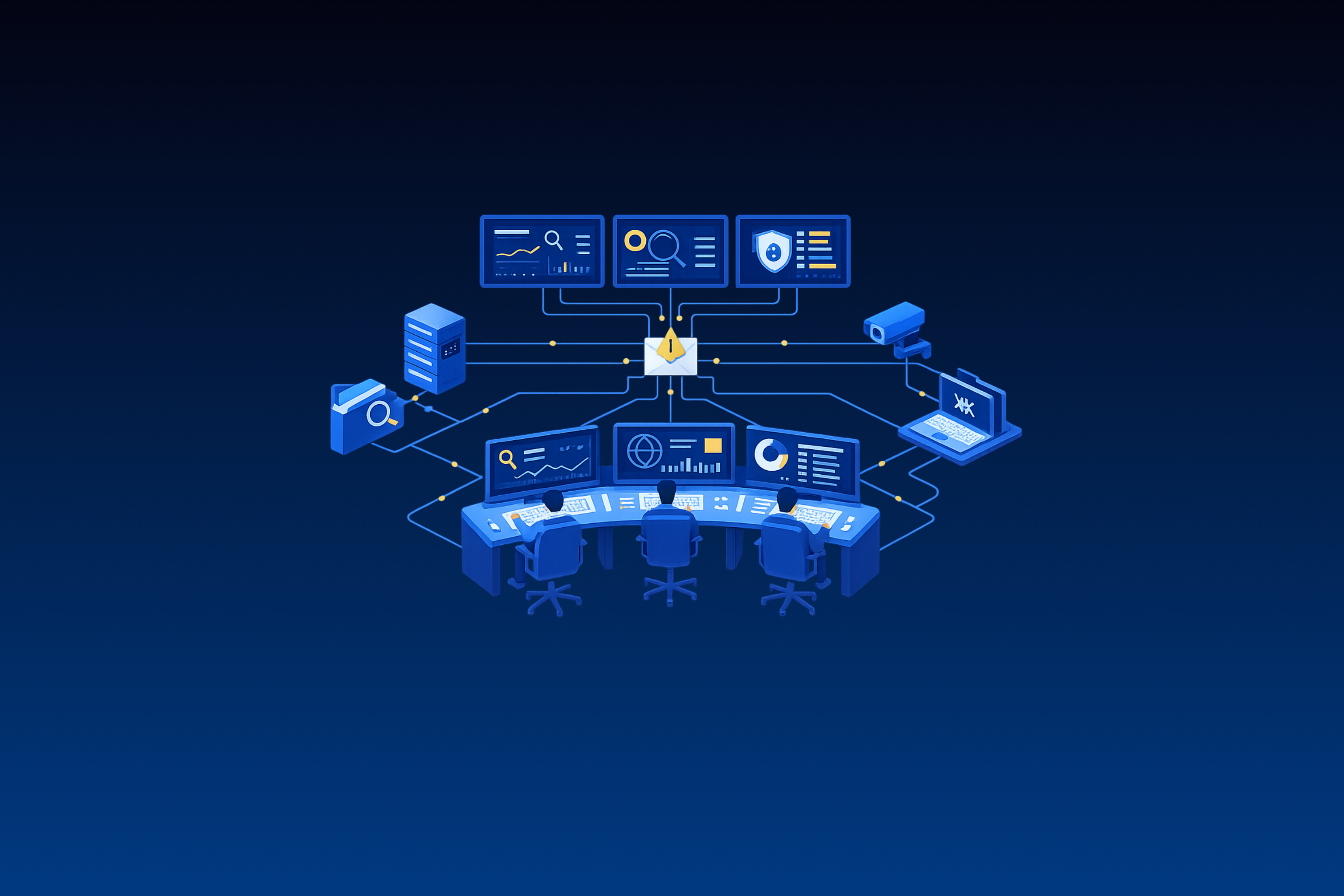
Security orchestration is the connective layer between security tools. It governs the "when," "how," and "in what order" of security operations: routing alerts to playbooks, sequencing enrichment queries, managing dependencies, and ensuring data moves consistently between systems that were not designed to talk to each other.
A Security Information and Event Management (SIEM) platform handles upstream data aggregation, analysis, and alerting, with varying levels of analysis depending on implementation. Security Orchestration, Automation, and Response (SOAR) platforms bundle orchestration with automation and response into an integrated operations platform. Writing playbooks is a tactic inside orchestration, not orchestration itself. Orchestration is the connective tissue, not the brain.
Orchestration, Automation, and Response
Orchestration connects tools and processes by coordinating interdependent security actions across workflows and infrastructure. Automation executes specific tasks inside those processes, such as querying a feed when a given indicator appears. Response is the containment and resolution layer: isolating a host, revoking credentials, closing a ticket.
All three depend on a fourth layer the category rarely names: the decision layer that chooses what to orchestrate, what to automate, and when to respond. In standard SOAR, that decision logic lives inside human-authored playbook branches.
The system follows the branch. It does not evaluate whether the branch is appropriate. When a situation falls outside defined branches, the system stops or routes back to a human. That fourth layer is where outcomes live and where most orchestration deployments fall short.
How Security Orchestration Works in Practice
Most orchestration platforms execute a variation of the same pipeline, regardless of vendor or deployment model. An alert fires in an upstream system, flows through four operational stages, and exits as either a resolved case or a ticket routed to a human. Walking through it end-to-end makes the mechanics concrete.
Ingestion and Normalization
An alert arrives from an upstream tool: a SIEM detection, an EDR signature hit, a user-reported phishing email, or a CSPM finding. The orchestration layer receives it through a pre-built integration and maps tool-specific fields into a common schema. One tool's "source_ip" becomes the same field as another's "srcIP" so downstream logic does not have to reason about every vendor's formatting choices.
Routing and Enrichment
Based on alert type, severity, and matching criteria, orchestration selects which playbook to run. The playbook then queries additional sources: threat intelligence feeds for file hash reputation, identity systems for user risk context, asset inventories for host criticality, historical tickets for prior related incidents. Each query result gets appended to the alert context.
Conditional Branching
The playbook reaches a decision point. If a file hash matches known-malicious threat intelligence, proceed to containment; otherwise, route to the analyst queue. This is where most orchestration gets stuck. Most real-world alerts do not cleanly match predefined branches, and the playbook defaults to handing the case to a human.
Action Execution and Logging
When a branch completes, orchestration executes the associated action: isolate a host via the EDR API, revoke a session in the identity platform, quarantine an email, open a ticket, notify a Slack channel. Every step, query, branch, action, and timestamp lands in an audit log for downstream review.
When the inputs are structured and the alert fits a known playbook, this pipeline executes in seconds. When the alert falls outside any defined branch, which is common with novel attacks, business email compromise attempts, and alerts requiring organizational context, the pipeline halts at Conditional Branching and routes to a human.
Why Orchestration Alone Does Not Deliver the Outcomes Teams Expect
Orchestration is the foundation. The foundation alone does not produce good decisions. Three structural reasons explain why.
Playbooks Are Brittle
Static playbooks rely on predefined decision branches at build time, a design property rather than a configuration problem. Workflows are fixed, decision logic is rule-based, and adaptation to novel threats requires manual playbook engineering.
In practice, this brittleness shows up in three ways. Playbooks become obsolete as environments change. Maintaining them drains already-stretched teams. And when the logic falls behind, threat handling becomes inconsistent.
Integrations Break Constantly
The orchestration layer depends heavily on integrations working correctly all the time, and that is not how the tool ecosystem behaves. The SANS 2023 SOC Survey reports that many SOAR-using organizations frequently change workflows, whether through analysts and SOAR users (26.1%) or through dedicated staff (17.4%). About a third (34.8%) report making little change since initial deployment.
Context Is Missing in Most Environments
Orchestration moves data between tools. It often does not carry sufficient business context needed for a good decision: whose account this is, what this user's normal behavior looks like, what access they have, what process governs their role.
Without that context, orchestrated data just arrives in the next tool as raw data. The decision quality does not improve. It just arrives faster. The limit of orchestration is not the connective layer. It is the decision layer that sits on top of the orchestrated data.
What Orchestration Is Actually Good At
When the orchestration layer is running cleanly, four operational outcomes show up reliably. None of them is the full SOC autonomy the category was originally pitched on. All of them are the wins that make orchestration a genuine foundation rather than a marketing promise.
Faster Containment Of Low-Ambiguity Threats
For alerts with high-confidence verdicts, malware hashes on a known-bad list, phishing submissions containing confirmed malicious URLs, logins from blocked countries, orchestration executes containment in seconds rather than the minutes or hours a human queue takes. IBM's 2024 Cost of a Data Breach Report links extensive use of security AI and automation to shorter breach lifecycles, and the containment layer is where that time saving materializes.
Consistent Execution Of Defined Playbooks
Orchestrated workflows do not drift under fatigue, context switching, or workload the way human operators do. A playbook that runs correctly once runs correctly the hundredth time, regardless of who is on-call. For SOC work where correctness is defined by following a procedure exactly, eliminating operator drift is where much of the real operational value sits.
Normalized Data Across Tools That Were Never Designed To Interoperate
Endpoint alerts, SIEM detections, and identity signals arrive in the same shape, with the same schema, in the same console. Investigators stop pivoting between six disconnected interfaces just to assemble a picture. Time saved on tool-switching compounds over the course of an investigation.
An Auditable Record Of Every Action
Every automated step, input, and output is logged with a timestamp in a single place. Compliance reviews, post-incident analyses, and any system trained on prior SOC outcomes depend on this record. A clean, queryable log of what the orchestration layer did and when is the precondition for trusting anything else it does.
These are the operational wins that make orchestration foundational. They are the substrate on which better decision-making becomes possible, not the outcomes the category was originally sold on.
Common Security Orchestration Use Cases
Five use cases illustrate where orchestration carries its weight and where the decision gap opens.
- Phishing alert handling: Orchestration normalizes reported emails, extracts indicators, queries enrichment sources, and quarantines confirmed malicious messages. The gap opens on business email compromise (BEC) attempts that contain no malicious indicators: every Indicator of Compromise (IOC) lookup returns clean, and the playbook has no mechanism to evaluate whether the request itself is anomalous. These cases often require cross-system investigation and human interpretation, which playbooks are not designed to handle.
- Endpoint malware triage: An EDR alert triggers enrichment, identity correlation, and containment workflows. The decision to isolate depends on whether that endpoint runs a production database or a developer workstation, business context that rarely lives inside the EDR.
- Identity compromise: Orchestration correlates unusual logins with Multi-Factor Authentication (MFA) data and executes session revocation. A sequence of individually low-confidence events, unusual login, MFA enrollment, mail forwarding rule, may not cross any single threshold. The attacker may have had hours of access before automated response fires.
- Cloud misconfiguration: Cloud Security Posture Management (CSPM) findings get detected, mapped to frameworks, and routed to asset owners. A public storage bucket might be an intentional architectural decision, and auto-remediation breaks the application.
- Threat intel enrichment: Indicators get deduplicated, correlated, and pushed downstream. Novel attacks, by definition, have no threat intelligence coverage. A no-results verdict looks like a clean bill of health while a novel attack proceeds.
Across all five, orchestration handles the execution layer. Scope assessment, business context, and risk calibration are where it falls short.
Where the Orchestration Model Is Shifting: AI and Agentic Systems
The decision layer on top of orchestration is where the market is moving. Gartner placed SOAR in the Trough of Disillusionment in 2024. GigaOm renamed its SOAR Radar to the SecOps Automation Radar in 2025. KPMG characterized legacy SOAR as reactive and insufficient. These signals point to an architectural shift in the category.
What Agentic Systems Change About Orchestration
Agentic systems decouple the decision logic from pre-coded branches and aim to replace static branches with runtime reasoning over live context. This shifts orchestration away from sequential playbook execution toward systems that evaluate goals and conditions at runtime.
The maintenance model inverts: teams can spend less time maintaining playbooks and more time maintaining the context the agent reasons over, asset inventories, behavioral baselines, escalation thresholds. The failure mode inverts too. When a playbook fails, the workflow stops. When an agent fails, it may reason incorrectly toward a goal rather than halting.
What to Watch Out For
Full investigation transparency is the non-negotiable requirement. If you cannot inspect the evidence chain, reasoning steps, and verdict rationale for any closed case, you have traded a brittle playbook for an opaque one.
Guardrails and accountability matter equally. Autonomous actions need explicit per-action authorization boundaries, and someone has to own the outcome when the system misclassifies. Gartner projects that over 40% of agentic AI projects will be canceled by end of 2027, and organizations that treat agentic deployment as a model procurement rather than a context engineering discipline are the most likely to produce that statistic.
Where Orchestration Ends and the Decision Layer Begins
Orchestration is the foundation. It connects tools, sequences workflows, and produces the substrate of normalized, enriched data that everything downstream runs on. The outcomes most teams were promised, fewer escalations, shorter investigations, security experts freed from mechanical triage, come from the decision layer that sits on top of that substrate.
The shift happening across SOC tooling is not about replacing the orchestration layer. It is about upgrading what decides what to do with the data the orchestration layer produces.
When the decision layer is sound, the operational pattern is recognizable. Containment runs consistently across shifts. Investigations reach verdicts that cite the evidence they rest on. The audit trail shows not just what was done but why, at the level a post-incident review actually needs. When the decision layer is brittle, fast execution of weak decisions produces the same alert fatigue orchestration was supposed to cure, at higher volume.
Frequently Asked Questions About Security Orchestration
What Is The Technical Difference Between Orchestration And Automation In Security Operations?
Orchestration defines conditions and sequences: what happens, under what conditions, in what order, with what human checkpoints. Automation executes individual steps without human intervention once orchestration logic determines they should run. You can have orchestration without automation (a workflow sequencing human-executed tasks) and automation without orchestration (a script triggered by a single condition). When alert response is too slow, the diagnostic question is which layer is the bottleneck.
Can Orchestration Replace A SIEM?
SOAR is downstream of detection and alerting. It receives processed alerts from SIEM; it does not produce them from raw telemetry. For raw log retention and historical event searches used as compliance evidence, you need a SIEM or other log management platform. Eliminating that upstream layer breaks the detection-to-response feedback cycle.
How Does Orchestration Change With Agentic AI?
Traditional SOAR executes predefined playbooks where the workflow is programmed for each scenario, while agentic systems pursue goals adaptively based on what they discover. The changed failure mode is the key risk: traditional SOAR fails predictably by halting when no playbook matches; agentic AI fails by reasoning incorrectly toward a goal, a failure harder to anticipate and detect. The trust baseline for expanding autonomous authority comes from extensive testing and demonstrated reliability over time, not from a capability purchase.
What Should I Look For When Evaluating An Agentic Decision Layer?
Three requirements. Glass box visibility: can you inspect the evidence chain, reasoning steps, and verdict rationale for any investigation? Guardrails: are autonomous actions bounded by explicit per-action authorization rules? Accountability: who owns the outcome when the system misclassifies? A decision layer that cannot satisfy all three is a black box with a different label.