What Is Identity Security Posture Management (ISPM)?

.avif)
Identity risk is continuous, but many organizations approach identity governance as a periodic exercise. That mismatch is the problem.
Most organizations run access reviews on a quarterly or annual cycle. Between those reviews, entitlements drift, service accounts multiply, permissions accumulate, and OAuth tokens proliferate across SaaS applications your IAM team may not even know exist. The access that was clean on certification day degrades steadily until the next review. Attackers don't wait for your review schedule.
Identity Security Posture Management (ISPM) closes the window between reviews. It continuously discovers, assesses, and helps remediate identity risks across human and machine identities, replacing the point-in-time governance model with always-on posture monitoring.
TL;DR:
- ISPM closes the gap between periodic access reviews and continuous identity risk. Quarterly certifications cannot keep pace with entitlement drift, dormant accounts, and machine identity proliferation.
- Machine identities are a large and often underaddressed part of the identity attack surface. In many environments, non-human identities outnumber human ones by a wide margin, so any program focused solely on workforce accounts misses a substantial share of the exposure.
- ISPM is complementary to IAM, IGA, CIEM, and CSPM, not a replacement. Each tool answers a different question. ISPM answers whether access already provisioned creates security exposure right now.
What Is Identity Security Posture Management (ISPM)?
ISPM is the continuous discovery, assessment, and remediation of identity and access risks across both human and non-human identities in enterprise environments. The scope covers identities, entitlements, authentication configurations, and the relationships between them, spanning:
- Identity providers
- Directories
- Cloud IAM
- SaaS applications
ISPM continuously answers a single question: does the access currently provisioned in this environment create security exposure?
The defining characteristic is full coverage of both human and machine identities. A recent Gartner trend points to machine identity growth driven by cloud services, automation, DevOps, and GenAI. That growth helps explain why traditional governance frameworks, built around quarterly reviews of human user access, often leave a meaningful portion of the identity attack surface unmanaged.
Common Identity Risks ISPM Surfaces
Credential abuse is the most common thread. According to the 2025 DBIR, it appeared as the initial access vector in 22% of all reported breaches.
Most of the identity risks ISPM surfaces are either credential vectors or the conditions that make credential abuse easy.
- Over-privileged accounts with weak MFA coverage: CISA BOD 25-01 now mandates phishing-resistant MFA for highly privileged roles. In January 2024, Midnight Blizzard accessed Microsoft systems through a legacy test account that lacked MFA.
- Stale and dormant accounts: Dormant employee accounts can retain permissions indefinitely unless actively removed, expanding the attack surface over time.
- Legacy authentication protocols: Protocols like IMAP, POP3, NTLMv1, and basic SMTP auth do not support MFA. CISA BOD 25-01 requires blocking them because they still enable credential theft and lateral movement.
- OAuth token sprawl: SaaS and API integrations can create durable access paths that bypass interactive login controls, including MFA, when tokens are stolen or misused.
- Non-human identity compromise: Compromised API keys, stolen credentials without MFA, and long-exposed tokens all demonstrate that non-human identities often lack the same security controls as human accounts.
- Shared accounts and configuration drift: Each individual permission grant may be justified in isolation. The cumulative entitlement profile becomes the exposure as ad hoc changes compound over time.
None of these are novel. The problem is that most organizations only discover them during quarterly reviews, by which point the exposure has been sitting open for weeks or months.
Key Components of ISPM
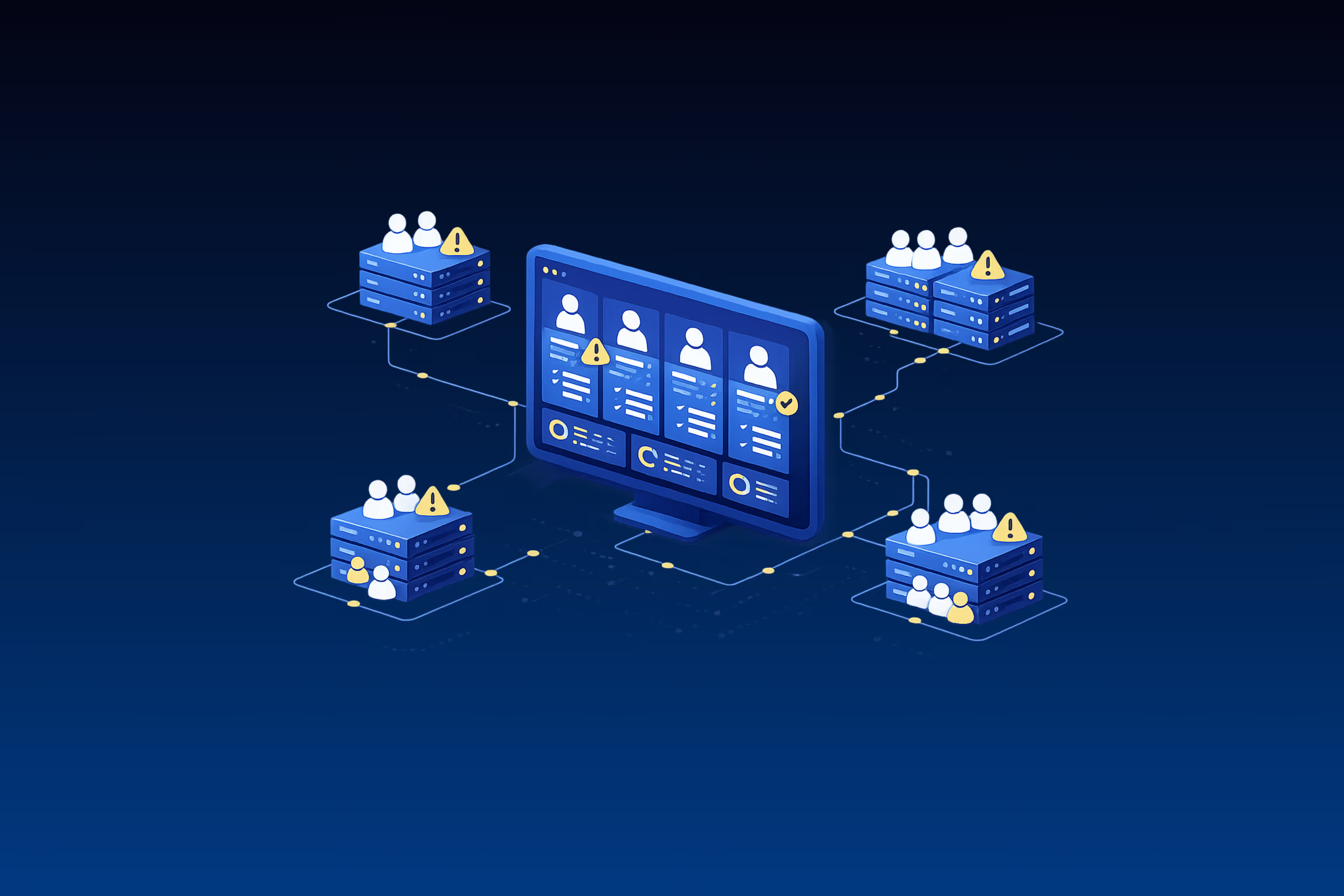
ISPM platforms operate through three interdependent functional layers that run continuously rather than on a review schedule.
- Continuous discovery: Automated inventory across every identity source in the environment. All identity types (workforce users, privileged accounts, service accounts, API keys, AI agents) with entitlements mapped, authentication paths identified, and shadow administrators surfaced. Discovery spans identity providers, cloud IAM, SaaS applications, and on-premises directories.
- Risk evaluation: Assesses misconfigurations, over-privileged accounts, toxic entitlement combinations, and dormant identities retaining privileges despite extended inactivity. More mature implementations map findings to attack techniques rather than presenting a flat misconfiguration list.
- Remediation workflows: The platform converts findings into security improvements through policy-based enforcement, least privilege remediation, and SIEM/SOAR integration for tracking.
The operational value is in the closed loop: discovery finds the risk, evaluation prioritizes it, remediation acts on it, and the cycle continues without waiting for the next quarterly review.
ISPM vs. CIEM, CSPM, and IAM
These categories are complementary layers in identity and cloud security architecture, not competing alternatives. The clearest way to think about boundaries is through what question each tool answers and when it operates.
When evaluating tools, the question is not "ISPM vs. CIEM?" but "which layer am I missing?"
How ISPM Supports ITDR
ISPM and identity threat detection and response (ITDR) are complementary layers with a clear division of labor. ISPM is posture hardening: continuously identifying what is misconfigured, over-privileged, or risky.
ITDR is threat detection and response: identifying active attacks in progress. ISPM reduces the identity attack surface. ITDR detects and responds to active abuse. Together, they close the loop between prevention and response.
Alert Confidence Lift
When ITDR detects a suspicious authentication event, the investigation quality depends on what you already know about that identity. If ISPM has flagged the account as over-privileged, authenticating through a legacy protocol, or showing weak MFA enrollment, the alert moves from ambiguous to high-confidence.
Posture Signals That Change Investigations
Not all ISPM findings carry equal weight for detection and response. What matters most are signals that show an identity is both exposed and positioned to cause damage. An over-privileged service account on a path to production data is a different investigation priority than a dormant marketing account with read-only SaaS access.
ISPM platforms that score findings by attack-path relevance give security teams the context to triage faster and act with more certainty.
Deployment Realities
The primary barrier to operationalizing ISPM is often political, not technical. ISPM deployment exposes legacy IAM process failures, oversight gaps, and poor cross-team communication. Achieving least privilege requires collaboration across app teams, data teams, cloud engineering, and IT.
Start with visibility-only mode before enforcement and prioritize high-risk production environments. Build exception workflows, so business-critical access is not revoked without alternatives. Plan for change management investment that matches the technical deployment effort. The tooling is the easier half.
Why Credential-Based Attacks Demand Agentic Investigation
The identity threat environment has shifted. Credential abuse and the use of legitimate tools increasingly dominate intrusion chains. That pattern shows up consistently in breach reporting and incident investigations. Attackers increasingly do not need to exploit a software vulnerability at all. They log in using valid credentials.
This shift has a direct implication for investigation: you cannot detect "logging in with valid credentials" without behavioral baselines that define what normal looks like for every identity. And you cannot investigate identity-related alerts effectively without correlating authentication events with entitlement data, device history, organizational context, and behavioral patterns simultaneously.
ISPM makes this investigation depth possible. Over-privileged accounts, legacy auth paths, dormant identities: these are not just posture findings. They are the organizational and historical context that turns an ambiguous authentication event into a high-confidence verdict.
Organizations that pair continuous identity posture management with identity threat detection close the gap between knowing what's misconfigured and catching active abuse of those misconfigurations.
Frequently Asked Questions About Identity Security Posture Management
How Does ISPM Handle the Ratio of Non-Human to Human Identities Without Creating Unmanageable Finding Volumes?
Effective ISPM implementations prioritize NHI findings through attack-path analysis with different risk weighting. Service accounts with admin privileges and no rotation policy on a path to production data get escalated. But service accounts with read-only access to non-sensitive development resources get logged but not prioritized.
What Does "Toxic Combination" Actually Mean in ISPM?
There is no universal standard definition. What constitutes a "toxic combination" is environment-specific, such as an identity that can both create and approve its own access requests.
ISPM platforms flag these based on configurable policies, not a fixed ruleset. Security teams should define toxic combinations based on their own risk model and separation-of-duties requirements.
If ISPM and ITDR Are "Two Sides of the Same Coin," Should I Deploy Them From the Same Vendor?
Not necessarily. The integration quality between ISPM posture data and ITDR detection matters more than shared vendor labeling. Evaluate based on whether posture findings can enrich investigations in real time, the depth of coverage per layer, and operational fit with your existing workflows.
The worst outcome is deploying both from the same vendor and discovering the "integration" is a dashboard link rather than real-time enrichment.